

‘The Casablanca Art School’. Tate St Ives, May 27th to January 14th 2024, and in Sharjah Art Foundation, United Arab Emirates, from February 2024
This show at first viewing struck me as very colourful and reminded me of seventies hard edge painting in UK
 | ||||||
| Mohamed Melehi 1969 |
It seems, free of French colonial rule at last 1956, Casablanca Art School developed to follow the prevailing western style.
I was a bit disappointed, expecting something more different from the 22 artists I had never encountered before.
It was the brown more political and savage pieces by Farid Bekahia, 1961, about torture under the French regime and the spirit of revolutionary victory in Cuba that attracted me.
 | ||||||||
| Farid Belkahia Torutres, 1961-2 |
 | |||||||||||||
| Farid Bekahia, Cuba SI, 1961 |
Coming back to see it all again I slowed down to read the captions and view the slide shows. This showed me that a lot of art was placed in the streets on the walls.

There’s a photo of students irreverently accessorising a classical statue - their studies now turning to the local design of jewelry, carpets etc.

 | |||||
| Melehi's notebook |
Astonishing facts are found in the wall texts but not highlighted in any way.
In colonial times classes at the art school had been divided not just by gender but by social class.
One of the female artists, Chaibia Tallal had been forced to marry at a very young age, but this I found out from chatting to an attendant, its not in the captions.
 | ||
| Chaibia Tallal , Marriage Ceremony, 1983 |
Two teachers of graphic design were imprisoned for Marxist tendencies for 6 and 8 years by the new Moroccan rulers but this is a brief reference which I would have liked to learn more about.
There are some poster designs that feature Palestine but the show does not enlighten us about these.

Ken Turner as an artist is an old campaigner, now aged 95 he gave a remarkable hour long talk, standing up throughout and making it memorable by smashing a rather nice bone china cup with a hammer to show how things have a life and change, and then making an action painting, narrowly missing splattering the audience of interested cognoscenti with paint.
Ken shook the bottle of paint up and down and squirted it out - rather an invitation to Freudian interpretation. One bottle was a bit stuck at first. However, then he made the splurges into something else with a few flourishes of a brush.
This took place in the Borlase Smart room at Porthmeor studios where Ken has a show of large abstractions until the end of July. These vigorous expressions have titles to which it is sometimes
hard to see the connections in the images.
However Ken Turner’s talk was about art and life rather than his exhibition or his lavishly illustrated available book, ‘A Life Being Ken Turner’.
He referred to Heidegger and other philosophers, to the chaotic state of the world, the art world’s deplorable market, and the need for aesthetic education to sensitise people to the forms and experiences they meet and make.
Dyhano asked if another person’s work would do just as well without the Heidegger connection?
Ken invited us to dwell on the importance of the life of things, to value feelings, to see that art can embody all that the artist has become.
The force of his conviction held us involved as participants in the event and its theatricality left an impression that I turned over in my mind as I walked home.


A project on involuntary childlessness.
Recently I joined a group of childless women who wanted to have children in a project run by the artist Melanie Stidolph, called ‘Dusk till Dawn’.
I attended several sessions where we met but I did not join the final one to film at a beach as I thought it would be too physically demanding for me as it required dusk and dawn performances with an overnight stay in a bell tent or nearby youth hostel.
I also had misgivings about the way the whole thing was going.
I have been in collaborations before - on my MA we tried and wrote about the process. Way back in Brixton Womens’ work I participated in three things in the 80’s in which I felt I was an equal artist member.
Melanie was working with a group not all of whom would say they were artists or singers.
It was wonderful to meet with childless women and hear their moving stories. It was a worthy idea for Melanie to embark on. But we were volunteers helping her realise her idea, not collaborators.
Were we a little more than the anonymous folk who make Anthony Gormley’s clay figures to his formula - or the workers who made Judy Chicago’s ‘Dinner Party’ embroideries to her exacting standards? - well at least we were credited in this case and we did get meaningful meetings.
Collaboration would require more time and few preconceived notions of the result.
Melanie had already engaged the excellent Clare Ingleheart to conduct us and to write part songs.
She probably had the costume people in mind and she had decided the performance venue, which had to be changed to get permission to another rocky beach near the original choice.
Melanie had work about her theme in the Exchange show, ‘We are floating in space’ and as this was all about artists using the coastline I realised as I left the premier of her film that the childlessness was shoehorned into the coast idea perhaps to get this painful subject shown.
People shy away from childlessness in life and art as I know from trying to show my own work about it. (available now on axisweb and Vimeo and on Jody Day’s instagram ‘Gateway’ )
I have to applaud Melanie for her project, and thank her for the opportunity.
The best part, the raw emotional impactful part was the talking with the other women, and we heard also of the singing done that was not filmed after the crew left.
Time was spent although it seemed rushed along and a lot of money was available for equipment and crew - the paid people- from the Lottery and Arts Council.
The flashing lights in the video triggered by sound seemed meaningless and gimmicky and might warrant an epilepsy warning.
I feel the costumes looked like the handmaid’s tale, the film was too long and slow, the whole subject was diluted to the point of being completely lost. Why was it at the beach? Why was it made into a sort of ritual ?
As for the wonderful group - I was removed from the what’s app as soon as I said I wasn’t going to be in the performance.
Will we meet up? There would be scope for a therapeutic online thing, for a booklet about the moving stories but I doubt it will happen.
The premier was shown at The Exchange, Penzance, projected in a pale way not in a dark rooom but on a wall at a neck crooking height - much better on the video screen where the colours were vibrant. The discussion was mostly inaudible despite me asking twice for them to speak louder and the eventual production of one microphone.
The subject is an important one.
Perhaps one day we can have a whole show about childlessness.
Lubaina Himid talking at Porthmeor Studios. May 23rd 2023
Lubaina Himid is an engaging speaker - a Professor of art and winner of the Turner prize and no stranger to St Ives, where she said trying to paint the sea from observation was what first showed her the allure of paint. She feels like an imposter since she was never taught how to paint but I don’t think students have been taught any painting techniques on fine art courses since 1970?
Here in the daylight lit high ceilinged studio with no sea view she has felt free of the attractions of naturalism and her love of simplified bright shapes is clear.
She says galleries don’t have such daylight and rarely light shows well.
Most of the large works were from a series called ‘street sellers’ and are destined to be shown in New York.
The images of the black sellers of baskets, shells and ribbons, or chickens, relate to the black figures included in eighteenth century British paintings such as by Hogarth, where often black figures were slaves, included without concern for their plight. Lubaina thinks about what it’s like to be a street seller performing , connecting with passers-by in a different way from shop sellers. It made me think of all those black sellers of stuff I have encountered on Greek beaches about whose lives I have found out so little.
Lubaina often paints the backgrounds before the figures and she operates as if she knows these people. She speaks of dialogue between figures and of moments where decisions are made after which one’s life goes in a direction as a result.
She says the chicken seller, who has no chickens and whose baskets are too open to keep a chicken enclosed is ‘kind of broken hearted’.
We learn all sorts of fascinating and amusing details about various other works, about how this artist is always looking to try out new things, thinking and feeling in various directions like her cast of characters.
Afterwards Lubaina Himid answered questions very thoughtfully.
I noticed she did not pause before telling us about the content to ask what we understood from the images with no further information. I am always keen to find out what I have communicated via images because I hope to get some things over clearly and to hear reactions which can show surprising other interpretations from my intentions.
Lubaina is so successful now and maybe doesn’t care to find out what we understand.
As so often happens I don’t think the wealth of ideas and feelings she puts into her work can be received by looking at it.
The delicious soup afterwards and lively conversations made it a really pleasant occasion where artists and others meet to enjoy art in St Ives.
(It was a pity it started half an hour late with no explanation or apology.)

Exist Otherwise The Life and Works of Claude Cahun

by Jennifer L Shaw 2017, paperback 2023
Claude Cahun’s art was known to me via a handful of photos and I knew little of her life before reading this account.
It’s a very beautifully designed book. There are four chronological chapters and an appendix of a few translated documents and a useful index.
Claude Cahun chose her name and from an early age was concerned with her own image and identity as a lesbian, inspired by male queer writers and the idea of an Ancient Greek utopia. Her relationship with her mother was fraught and as her father was Jewish she suffered from anti semitism. She met her lifelong partner Suzanne Moore when they were both teenagers.
Claude had enough money not to need a job and moved in avant garde arty circles in Paris. She wrote the stories of various heroines such as Eve, Sappho, Judith and others, reimagining them from. a modern viewpoint. In self portrait photos made with her partner she played with masquerade doll like roles using androgyny and theatricality. Jennifer Shaw discusses the possible sexual symbolism in Cahun’s montage images.
During the thirties Claude met Breton and other surrealists, made playful photographs and joined in turn various political groups of artists to combat fascism. She veered towards Trotsky’s idea of individual freedom for artists to express their inner world and in 1939 signed a manifesto that declared ‘there will be no freedom until everyone is free’. Aragon criticised her as essentially bourgeois in her individuality.
Her strange constructions were photographed as illustrations for a disturbing children’s fairytale book by Lise Deharme.
After the wealth of references and names of well known surrealists that Claude knew and enough details of her work to establish that she should be part of the canon of art history, the last chapter in which she is living in occupied Jersey with her partner is by far the most fascinating.
Claude and Suzanne agreed to devote themselves to placing anti war propaganda in a variety of inventive ways in their environment. It was written as if by a disillusioned German soldier, aided by Suzanne’s fluent German language and the two of them spent a lot of time on this and put themselves at great risk.
Eventually they were arrested, sentenced to death and put in solitary confinement, saved from deportation by the progress the allies were making towards winning the war. Claude called this work ‘militant surrealist action’. She despised the Jersey population’s failure to resist the nazi occupation and hoped to affect the behaviour of those German occupiers who could be influenced against Hitler.
Their prison experiences and subsequent release are remarkable and could make a wonderful film. Unfortunately Claude’s health was broken and she died, 1953, before their plans to return to liberated Paris were carried out. Suzanne Moore remained in Jersey, killing herself in 1972.
The wartime story is such a humdinger - I found it very moving and amazing and highly recommend the book for that well researched and fluently written account.
Lamorna Colony Pioneers
3 May 2023 until 30 September 2023
An exhibition at Penlee House co curated with David Tovey whose new book, an in-depth study of the colony, Lamorna – An Artistic, Social, Literary History, will be available during the show.
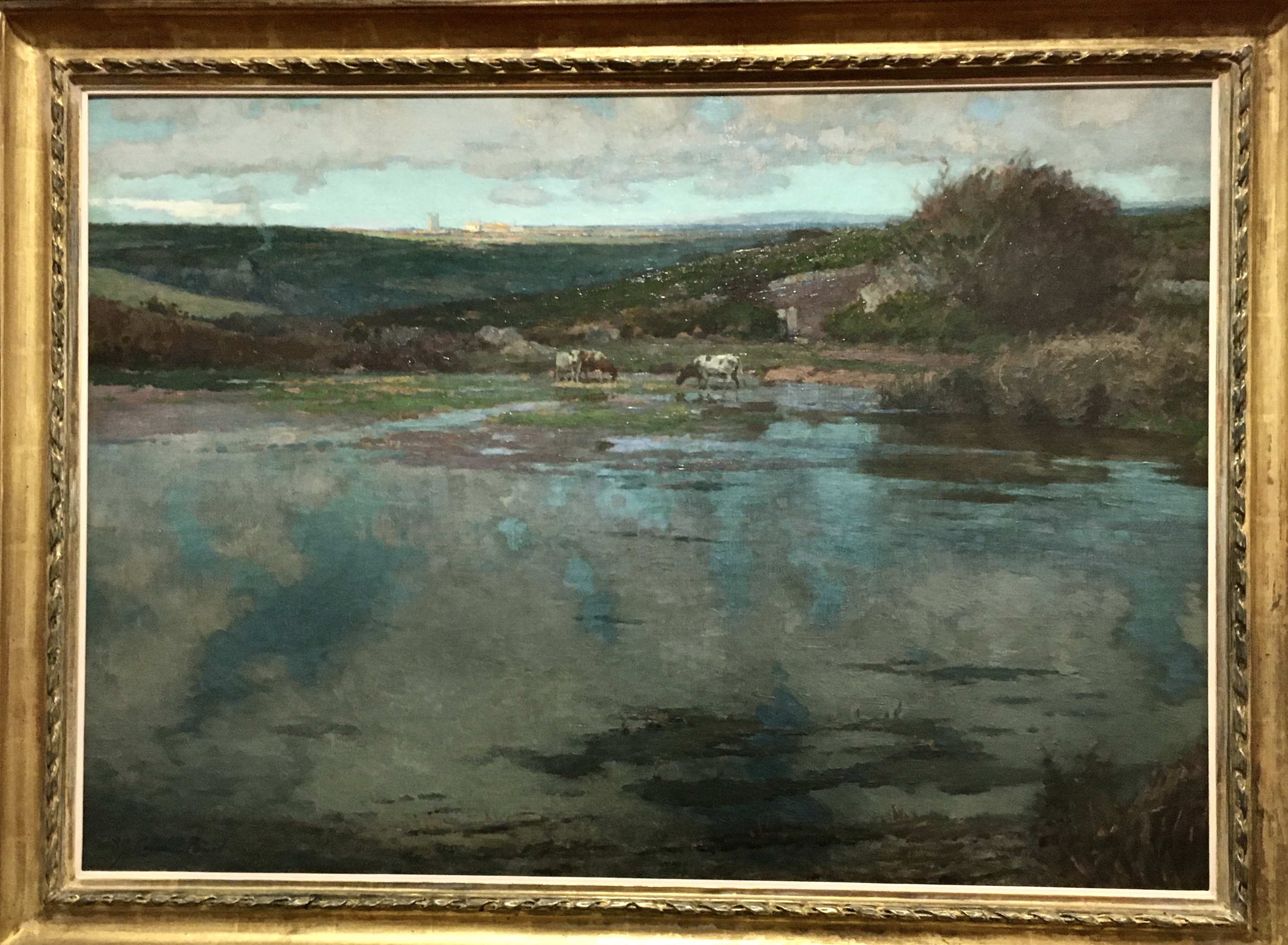 |
| Lamorna Birch, St Buryan-the Fowling Pool, 1907 |
There is a quite astonishing contrast between the first picture in this show and the last.
 |
| Marlow Moss,Composition Yellow,Black and White, 1949 |
How did art go from looking carefully to observe life to constructing simple abstract compositions?
There is no catalogue for the show but the labels give interesting information which is not too lengthy to take in.
I found I was absorbed in the paintings - the way they were done - and also fascinated by the stories of the artists and their bohemian enclave.
Then there is also the visual information of what the artists were observing of life, the social history, the clothing and interiors as well as landscape.
So, three aspects that make it a really enjoyable experience.
 |
| Munnings Cattle watering in a stream, Zennor |
I found the surprise for me was just how lively Alfred Munnings’ work is. Its the wildness of his bruhstrokes that I noticed. A close up of a section of a painting of cows in a field could be a twentieth century abstract expressionist work.
 | ||||
| Munnings , detail from 'Cattle Watering in a stream, Zennor, 1912 |
Munnings I know made a notable speech denouncing Picasso as a charlatan, at the Royal Academy, but he was more modern unconciously than perhaps he realised.
The item I would have liked to take home with me was a ceramic figure of Laura Knight made by Ella Naper. It reminded me of similarly lively works made by the early artists of the Russian Revolution with its vigorous charm.

Ella had modelled for Laura Knight’s ‘“Spring’ of 1915, the landscape background of which the painter risked incarceration to draw as during the first world war outdoor drawing was banned.

There are a couple of other Knight’s, and in ‘My Lady of the Rocks’ there’s rather an awkwardly proportioned figure as if collaged on top of the landscape.
Dod Proctor’s ‘The Steps at Oakhill Cottage’ 1910, is a delightful early work of observation.

Harold Knight’s ‘Portrait of Robert Morson Hughes’1915, is startling in its use of space in the composition after so many detailed landscapes. Apparantly it was a study for a work of a group of men originally entitled ‘’How to win the war’ as they sat talking in The Wink pub, but it was retitled less bluntly when shown at the RA.

Coincidentally Rupert White’s ‘Magic and Modernism’has just been published, which describes the two paths of modernism and surrealism, the latter an uncensored anti bourgeois disorder whereas modernist abstraction aimed to make a more harmious world after the chaos of war. And we see these two divergent approaches in the work of Ithell Colquhoun, and John Tunnard - both weird and surreal and Marlow Moss with her constructed order.
 | |
| Ithell Colquhoun, Rock Pool, 1957 |
How varied art is
 |
| John Tunnard, Arena, 1959 |
- observation, imagination, chaos and calm and a treat from way down in Lamorna.
