Lamorna Colony Pioneers
3 May 2023 until 30 September 2023
An exhibition at Penlee House co curated with David Tovey whose new book, an in-depth study of the colony, Lamorna – An Artistic, Social, Literary History, will be available during the show.
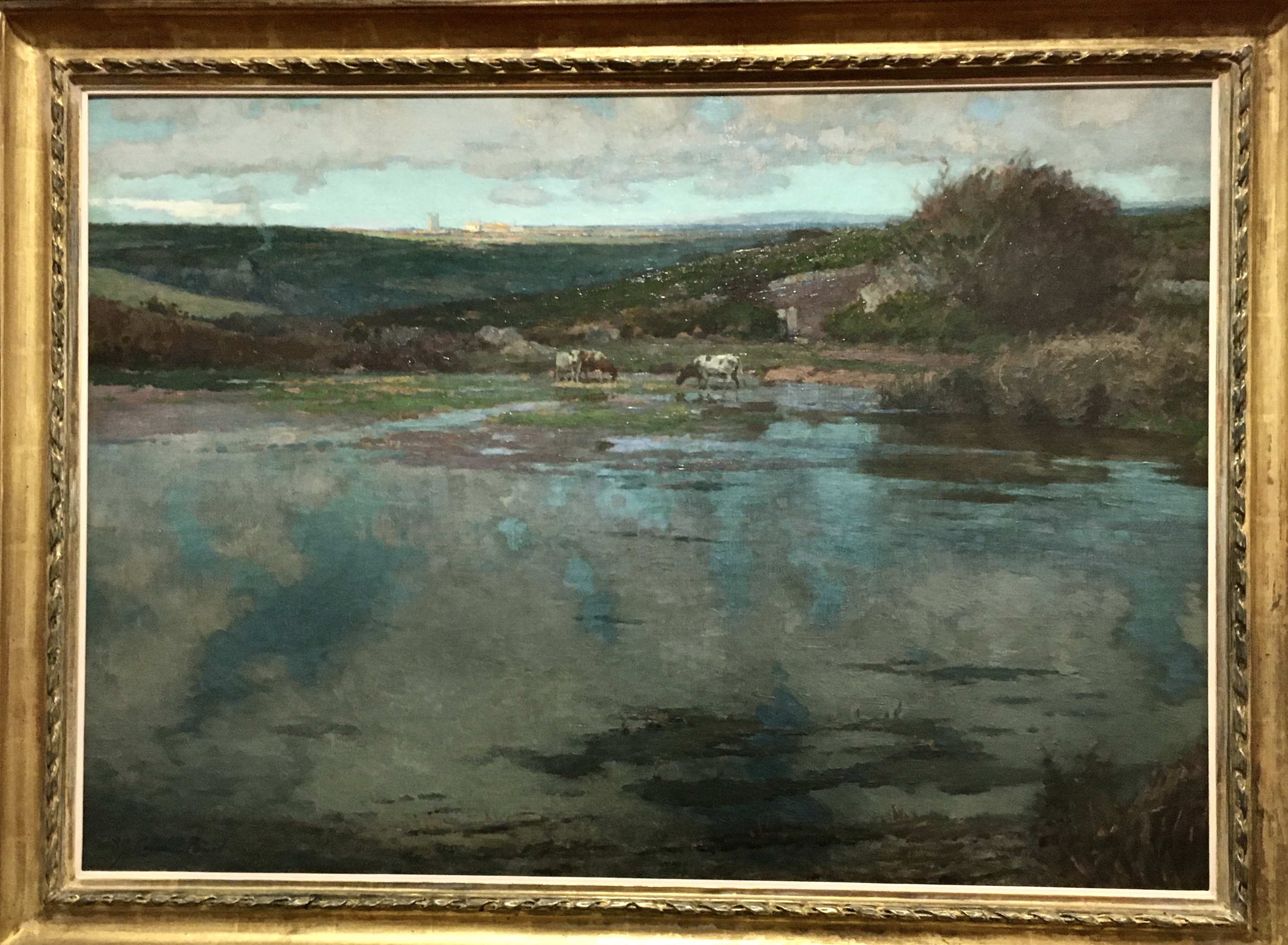 |
| Lamorna Birch, St Buryan-the Fowling Pool, 1907 |
There is a quite astonishing contrast between the first picture in this show and the last.
 |
| Marlow Moss,Composition Yellow,Black and White, 1949 |
How did art go from looking carefully to observe life to constructing simple abstract compositions?
There is no catalogue for the show but the labels give interesting information which is not too lengthy to take in.
I found I was absorbed in the paintings - the way they were done - and also fascinated by the stories of the artists and their bohemian enclave.
Then there is also the visual information of what the artists were observing of life, the social history, the clothing and interiors as well as landscape.
So, three aspects that make it a really enjoyable experience.
 |
| Munnings Cattle watering in a stream, Zennor |
I found the surprise for me was just how lively Alfred Munnings’ work is. Its the wildness of his bruhstrokes that I noticed. A close up of a section of a painting of cows in a field could be a twentieth century abstract expressionist work.
 | ||||
| Munnings , detail from 'Cattle Watering in a stream, Zennor, 1912 |
Munnings I know made a notable speech denouncing Picasso as a charlatan, at the Royal Academy, but he was more modern unconciously than perhaps he realised.
The item I would have liked to take home with me was a ceramic figure of Laura Knight made by Ella Naper. It reminded me of similarly lively works made by the early artists of the Russian Revolution with its vigorous charm.

Ella had modelled for Laura Knight’s ‘“Spring’ of 1915, the landscape background of which the painter risked incarceration to draw as during the first world war outdoor drawing was banned.

There are a couple of other Knight’s, and in ‘My Lady of the Rocks’ there’s rather an awkwardly proportioned figure as if collaged on top of the landscape.
Dod Proctor’s ‘The Steps at Oakhill Cottage’ 1910, is a delightful early work of observation.

Harold Knight’s ‘Portrait of Robert Morson Hughes’1915, is startling in its use of space in the composition after so many detailed landscapes. Apparantly it was a study for a work of a group of men originally entitled ‘’How to win the war’ as they sat talking in The Wink pub, but it was retitled less bluntly when shown at the RA.

Coincidentally Rupert White’s ‘Magic and Modernism’has just been published, which describes the two paths of modernism and surrealism, the latter an uncensored anti bourgeois disorder whereas modernist abstraction aimed to make a more harmious world after the chaos of war. And we see these two divergent approaches in the work of Ithell Colquhoun, and John Tunnard - both weird and surreal and Marlow Moss with her constructed order.
 | |
| Ithell Colquhoun, Rock Pool, 1957 |
How varied art is
 |
| John Tunnard, Arena, 1959 |
- observation, imagination, chaos and calm and a treat from way down in Lamorna.

