Monday, 18 November 2013

Transitions Week Two Newlyn 2013

Transitions November,  Newlyn Gallery, week two. Nov 2013 until 16th

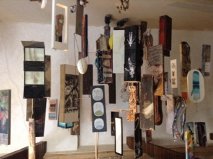
Upstairs Jonty Lees has placed attractively all the way round the beautiful gallery different pieces of wood, some coloured, different sizes and shapes. Visitors are invited to make a sculpture by placing their selections together and he will then take a photo, as the wood will be re-used for other compositions by other people.
He has a video of his small daughter doing this also.
Its tempting and not too taxing for people as there is no mess, and somehow he links this with work he has had at Trelliske on a residency beside Doctors who are seeking to tell us all that being outside in fresh air is good for us. There is a link for Jonty between their ways of looking at data and how variedly the visitors will assemble what they are given to play with.

Its like a much more sophisticated lego but with no joining bits and its very enjoyable.


Downstairs Janet McEwan and Ann Haycock have ‘We are not petrified’, a title I love, which refers to the dancers of Merry Maidens local stone circle fame. They have films of dance, wigs to make you feel different, a poet coming in also, a toy accordion I enjoy having a go on , and a pile of handbags the maidens have put aside while they dance.
There were two delightful 16mm projectors when I was there, so stoutly built and making a lovely sound, and Janet was projecting a loop onto and round a handheld stone which was an unusual idea. and the stone was scraping the emulson off the film.
So again it was very playful and fun and an Ithell Colquhoun [1906-88]


painting of a sort of sexual surrealist kind had been borrowed from Penlee.


Much discussion re technology, why people like film rather than digital, etc.


Two more weeks of Transitions, I hope lots of folk will drop in there.

Wednesday, 13 November 2013

Transitions, Newlyn Gallery, November 2013

Transitions November 2013 at newlyn Gallery

So what .. is going on at Newlyn?
Its all very folksy and spiritual, shamanic and flakey as a filo pastry-but is it as tasty?
Its the filling that attracts, Kate Waters very beautiful watercolour paintings of strange animals. Sue Bleakeley’s quirky materials, copper wire, black and red plastic, and downstairs corn dolly off shoots..
They’ll talk to you, but note to self to try to offer seating and refreshments if doing these things.
Most amazingly Sue brought in a friend and gave her some space, Alexandra Karrasch, who is drawing with an electric drill and carbon paper.

So, it comes down to if you happen to like it, like any art show.

The main thing I take from it is that we have art just as odd, worthwhile etc. here as anywhere and its a pity so little time is given to it and so much to the more famous, apparently, from elsewhere-their shows go on and on and on, and they themselves are absent, these transitions are over so quickly its difficult to catch them but the artists are here, a great treat to talk to them.

There is lovely Greek orthodox music and a table of books - Giotto, dreams etc.etc.
I feel at first total incomprehension, onions ?- flames, a black and red thing I like but Sue says its negative and the blue cocoons are about water.


I ask downstairs why do all this and get a surprise
answer that the artist likes working with corn stalks. Anne-Marie Culhane puts on performances, outside parliament for example, but with no leaflets or notices so you can’t tell what they mean. She is aware of politics re big companies controlling seed supply etc. but none of this gets into the work. the corn mask strikes me as menacing, but not seen like this by the artist, who says a bit wearily when i speak of face hiding burkha’s that people keep saying that.


Do they want us to comment? I’m not sure. but it makes a strange morning and the cafe is welcome with its fantastic ocean view.


3 more varied weeks to go.


Thursday, 15 August 2013

Dhyano at The Arts Club, St.Ives August 2013


DHYANO

What to say? It's not easy to describe this zany 'futurist' show. In brief I would say it was brilliant and Dhyano is a comic genius.

It's two hours but not too long.
On the 7th there  were two guests, Shanti Baba and Steve Litherland who were both  entertaining.

However, it's Dhyano we had gone to see, whose humour is very visual , but also with a love of sounds generated by himself and the audience when he invites participation,( and this is not creepy or threatening). 

Dhyano throws himself into the act with amazing intensity and wit, commenting on his Uncle who sold Pilchards in Italy on his return from Australia, on the self absorption of artists, the origins of Tate, on seagulls, train travel, socks, Italian food.
 However, mentioning a few of the many subjects touched upon does nothing to convey the Dadaist nature of absurdity and complexity which connects diverse remarks and is delivered so eloquently, almost frighteningly ludicrous at times, touchingly soliloquising at others, and engages us completely so that we emerge refreshed into the night, trying to remember it all, enthralled  and delighted.

Don't miss this.


John Newling, 'Ecologies of Value, The Exchange, Penzance 2013


The leaflet describes John newling as ‘a pioneer of British public art with a social purpose’.

This interests me because I think art has a social and political significance whether intended or not and some of mine is definitely intended to have so I like to see what others have done.

Money and religion are  mentioned in the blurb for the show.

However, sad to say, I find the exhibition terribly dull.

It looks sort of portentous, very serious, little colour, repeated large formats, several huge glass dishes and some writing, some plants being raised hydrophonically, some balls of earth on top of copies of Tom Paine’s ‘The Rights of Man’, but you can’t read the book.

I start with the video, give it up because its a horrible noise of raucous out of tune singing coming through the headphones, try it again to find people one by one singing questions from hymns, give up on it again.

Newling has removed dirt from coins and weighed it, but I can’t see what significance this has. The dirt doesn’t weigh much, the coins are worth the same with or without dirt if you want to spend them.

He is ‘Emeritus Professor of installation Sculpture at Nottingham Trent University’ which I think is the other one, not the Notts University I went to in the 60’s.

This show is said to survey his work since the 1970’s, in which case it seems a bit sparse.

I am bitterly disppointed.
Where is the social and and economic addressed? 
Where is the ‘deeper questioning of value and belief?’
Its not in evidence in the work.

I offer my animated 3 minute version of the message of The Ragged Trousered Philanthropists by Robert Tressell,
you tube   ‘The Money Trick’ Mary Fletcher   should find it.

Monday, 10 June 2013

Summer Tate St.Ives , first and second looks.


First thoughts on the Summer 2013 show at Tate St.Ives.

The first room is all Marlow Moss. There's a book you can look at but it's out of print, not in the shop. A friend tells me it's quite possible Mondrian got his ideas from Moss, not the other way about. However, maybe he did it better? I don't like the awkward way some canvasses are attached to the frames or the way she has signed several on the front, spoiling the abstract design. Still it's great to see more than the usual one thing by her.

The curved gallery has some grey paintings, one with an attractive splodge of glitter by a woman called RH Quaytman.

Downstairs there are some lovely Hepworths, oddly paired with work by a woman who alters photos and produces old fashioned looking mildly amusing collages of women's hairstyles using shells etc. They are small. 
The blurb on the wall claims similarities in form and 'the spiritual' whatever that means, between Linder and Hepworth, which strikes me as ludicrous.
Presumably it is this artist called Linder who decided to mount the Hepworths on preposterously pompous huge geometrical plinths and hang a horrid white nylon curtain, like something in a temporary clinic, to hide the fantastic sea view. It is inelegant.


It's nice to see the Hepworth maquette with small marble if figures, made from a fireplace, but I want to  walk all round it and there isn't really room.
Hepworth figures with others seen through a window.

There's a ballet in the back room, choreographed by Linder and Tindell, filmed so that it focuses on certain partial views, whereas at a live ballet one chooses where to look so this film is rather frustratingly choosing  for us. I love ballet so I will be back to watch it.

In what sense can Linder be said to have a 'radical, feminist practice' as it says in the booklet? I cannot see any sign of it.

Back upstairs there is a space with three small harlequin designs, said to make 'a highly charged space' a description which makes no sense to me. It's the work of Gareth Jones.

In the next room there is a video by Nick Relph about tartan with lovely colours, overlapping images, and this takes my attention so I look forward to seeing it all through another day.
Next is a room about Heron  and Crysede and some letters he wrote home, textile designs, nice to see.

Last room. Audience participation, we can take up to ten pages photocopied from the artists's library. His name is Allen Ruppersberg. 
(Is it significant that the women artists conceal their gender by not having recognisably women's names?)
 Apparently the whole display , how the boxes are placed etc. was minutely planned and done.
 It's fun to take stuff and think why I am choosing it.  I notice a lot about women poets and also choose an image if the Taj Mahal because I have been there. I am seeking connections between things and with me. I like the idea, wish I'd thought of it.

So, first impressions. A tremendous mixture -the contemporary less than astounding, the old not so very impressive either, apart from the Hepworths, which are shown in a rather perverse way.


Second Look at Tate St. Ives Summer show.
I went in again partly to do some drawings to illustrate my blog.
However, I decided to take the tour. There was only one other person, a woman, and the tour giver was Vicky Leach, who had chosen to show us the four women artists in the show, which I was delighted about.
Moss had wealth but also had the luck to be rescued from alcoholic stupor in a Paris gutter by Netty Nijhoff, a journalist who introduced her to important folk and became her partner and nurturer. They were separated in the war but reunited in Lamorna afterwards.
However, I decided to take the tour. There was only one other person, a woman, and the tour giver was Vicky Leach, who had chosen to show us the four women artists in the show, which I was delighted about.

We spent quite a time in the Marlow Moss room. It seems she was a follower of Mondrian after all, one he met and encouraged. In Cornwall she had not been able to move in the Nicholson / Hepworth circles and probably was cold shouldered partly because she was a lesbian. She changed her name fro Marjorie to the less gendered Marlow and presented herself with a male styled persona.


3D construction by Marlow Moss


Giving the work more time and hearing about the life of the artist made me much more appreciative of her. I wondered if Gluck, another lesbian contemporary, had encouraged her use of frames from which the paintings stick out in relief, as I know Gluck developed a specific type of frame for herself.
Next we turned to RH Quaytman, born 1961, who hid her gender in case it stopped her career progression. It turns out what I saw as decorative surfaces have significance as post 9/11 American images full of references to the twin towers. I now saw the red,green,blue stripes as possible references to t.v. coverage and Vicky suggested the glitter, actually diamond dust, was a metaphor for us all being being stardust.

Lastly we turned to Hepworth , wondering if pregnancy and motherhood had been expressed when they occurred, and seeing possible references to Cornish giantesses. Linder had also changed her name to remove the female gender first name of Linda.
She had been a feminist performance artist, but none of us knew of this.
We agreed that Barbara's keeping her gender clear was more help to women's aspirations and also that we had learnt from and enjoyed the tour
Linder Ballet, drawn from the film.


Before that I saw whole of Linder's ballet video and enjoyed it whilst wondering why the dancers wore strange head pieces as if ready to spin on their heads, which did not happen. They were all very thin and pale with dark 70's style eye make up and men in dark costume, women in muted lemon, pink and brown with a subtle hint of animal print. They moved in complex ways, entwining and climbing over one another, and one amongst an audience seated on the floor, like anaemic, timid creatures from another galaxy, to live electric music a bit like the bbc electronic workshop, Dr Who, tubular bells shades of. The lighting cast long shadows and the overall effect was mesmerising and soothing. An attendant agreed with me that the time of the video, about 25 minutes, should be displayed, and had asked for this to be done along with a photo of Hepworth's 'Family of Man' which was said to have inspired it.


I returned to the video about tartan and fashion etc by Nick Relph. Again no time was given. There are three videos, blue, red and green, shown superimposed as a 'restless collage' which I loved for its rich colours, like succeeding screen prints with snatches of audible sound track and a quote about turning off the mind to just look and enjoy abstract visual qualities. Tartan was referred to as 'saying where it comes from.'
So, there was a link with the three colours in the earlier paintings by Moss and by Quaytman and the three coloured projections, between the fashion in the hairstyle photos and the video and the cloth in the tartan references and the Heron fabric design.
Still rather a baffling show as far as being cohesive goes.
I'd missed my chance to invade the 'family workshop space' by taking so long looking around this time, but it seems invidious to exclude lone people without children from enjoying the art materials.
If you go to see this show I strongly recommend taking a free tour to hear some background and slow yourself down enough to enjoy the art work. Listening and contributing to discussion I find triggers the brain cells into action.


Monday, 8 April 2013

'Limbo"


‘Limbo’ at The Coffin Store, Walsingham Place,
Truro - March 28 to April 14th 2013

Subtitled “The first Biannual, forming a blueprint for a future biennale’

I suggest its not just conceived, instigated and supported by Joseph Clarke, Samuel Bassett, Jesse Leroy Smith and Neil Scott but also chosen by them?

Its not that easy to find the place, there’s rather a small notice behind a few arty looking people hanging about in front of it.

The first exhibit is a sculpture by Tim Shaw of a figure on fire, which someone we knew had told us about, saying it was based on a soldier on fire in Iraq, but I don’t know if I would have realised that unless I’d been told.
Its not really got enough space  and I am most moved by the title - ‘What God of Love Inspires Such Hate in the Hearts of Men’.


It turns out there is quite a lot to see in the show. Unfortunately its freezing cold, but after a while, finding things that interest me and getting into conversation I forget about that for a while, but its tough for those invigilating or working there.

My attention was caught by Alban Roinard’s video in black and white with words spoken in Cornish and subtitled. Its all about death and the sea and a child and remembering and its saying something that I linger to take it in again and try to learn how to pronounce a few of the Cornish words from my husband , Pedyr Prior, who can speak them. The sound is a bit low despite Jesse Leroy Smith noticing and coming over to turn it up with the remote.

A large area upstairs is given over to various artists painting from photos of famous people, but at first I don’t get what its about at all.
 Having spoken to Richard Ballinger we get into a lively conversation about suicide and include personal experiences, my online ‘Umanets petition’ protesting about the sentence of the Rothko scribbler, how and why Rothko killed himself, and how the TAap group put in a proposal for this item to be in the show. It fits well with being in a coffin store.
Its the conversation that is engaging and gets me to linger and look at the paintings and think about the subject and the fact that the paintings are being created on the spot.


There was a lot more. 
Unfortunately two electrically powered projections were not working.
 I presume one of these would have been the slide show documenting some of the many artists in ‘the south west’ which is an odd phrase to use if the future biennale is to be Cornish. 
There was neon, hanging things, paintings, sound [too loud for me] and  other video. There were socialist slogans on the rafters, which I was delighted to see. I don’t suppose the coffin makers did them?

This show made an impact and was quite a surprise just off Truro’s shopping area. 
Will it lead to a ‘Cornish Biennale’? Sounds exciting.
If so will I and many other artists in Cornwall hear about it in time to get involved? - I say this as I didn’t hear about this one until it was about to open.

Will there be a less male list of exhibitors?

Will there be more signage to get a few passers by to find it?


Anyway, well worth the trip and an inspiring spurt of energy in the art community.


Monday, 25 March 2013


13 people have spent all day arranging and installing our exhibition, over 80 hours of unpaid work, most unlikely to be repaid with any profit when the rent of the space and the other costs and invigilation time and travel are added up. Why do we do this? It's such hard work. I announced I would rather be a writer, just a laptop or a notebook to carry, no tools and lifting and co-operating. By the end of the day I am exhausted.
Beverley le Levier

Maybe on past data 2000 people will come and look over the two weeks of the show, most won't even buy a card or make a comment.
Christine Spencer-Green

The artists enjoy seeing their work on display.
We like to see people looking at it, getting something from it, occasionally someone even tells us they love it or understand it or are amused or moved or they even buy it, showing it’s valued. Someone thinks we are a good artist, they will remember our name.


Amanda Rae Thompson

Sometimes I think the pictures are just an excuse for signing our names: Kilroy was an avant garde artist, signing the world.

Helen Savage


We're not in the league where large amounts of money are made as investment. It's not the high stakes art market parallel to property speculation.
Jo Davies

It's more that we do what we damn well want to express ourselves, we own the means of production and we might make a few quid.

Janie McDonald
We'd like to be famous, well I would, so that our work would be more seen, known, remembered, make a mark on the culture, join the canon of art. We're as good as the more successful famous ones, we just haven't had the lucky breaks, we didn't know the right people, we failed to marry an art dealer, or the cognoscenti aren't ready for us yet.


Lorna Johnson
Actually when I admire some of my fellow members of Taking Space's art works they are as well done as anyone's, as original, as lively and sincere. Not all of it, I don't even like it all, but I defend its right to be shown.

It's a bit Groucho Marx, by being in this group we trumpet the fact that we are prepared to belong in a group that gives us no kudos but anti-kudos.

Joan Ford
But at least we are in a group, we do exhibit, we help one another in a democratic collective of women, we defy all those opportunities to be rejected by selectors we do not respect because all they do is choose what they like and their opinions are no better than ours.

We remember Van Gogh, to whom even a brother in the art racket couldn't ensure success in his life time. 

Mary Fletcher
Like that comic who said, 'When I said I was going to be a comedian they laughed' (it was Bob Monkhouse], 'They're not laughing now'.

We indulge our addiction to self expression, to drawing, to playing about with art materials, we imagine our willingness to carry on despite almost complete failure validates our vocation, we stand for something that defies the capitalist requirement for marketing and profit, even though we don’t object to earning enough to pay tax.

Come in, have a look, we can't stop, it grows like toenails, as I believe Picasso said, and we cut it adrift to put it into the world, more clutter, or just a re-arrangement of stuff, creation.

Twenty years of Taking Space and still going on!


Mary Fletcher.