Monday, 12 February 2024

Outi Pieski -a Sami Woman Artist at Tate St.Ives


                                            Flag of the Sami


Outi Pieski   Tate St Ives. February 9th  - May 6th 2024

Outi Pieski is a Sami artist from Finland.

The preview was buzzing with interested people delighted to see something new.
There are large hanging brightly coloured chevrons of long tassels which refer to the traditional clothing of the Sami, whose culture and language was suppressed for many years by Christian colonisers who regarded it as pagan and evil. The Sami are the only designated indigenous people in Europe.
More recently the Sami have revived their community and are engaged in struggles with the Scandinavian governments because their reindeer herding and salmon fishing is threatened by wind farms, hydro electric power and graphite mining - all part of green power developments.

Outi Pieski also presents her paintings, which are textured expanses decorated with textile, some with small ornamental figures added in front, some with tassels or ribbon or bejewelled with crystal gems.
These paintings are unlike anything we are used to and combine folk elements with abstract paint marks that evoke strange landscapes.

Then there is one area with grids of photographs of traditional women’s hats, red with other bright ornamental trims and a curved shape rising above the head. These are being found and ‘rematriated’ from distant museums. Outi Pieski has been involved in community workshops to revive the making of them.

The artist was present, wearing colourful traditional dress and the next day gave some talks with an interpreter and signer. Unfortunately the difficult acoustics that Tate has failed to overcome rendered the one I attended virtually inaudible but I heard the  unfamiliar Sami language and sensed a serious  artist very involved with especially the Sami women.

The lengthy labels and statements on the walls refer to many political issues and also to an implied belief in evil spirits. As often happens I felt these issues were not expressed in the art- which concentrated on being romantically evocative and attractively decorative. Some labels refer to a belief that women are the guardians of the earth, which I find a divisive view.

However I felt moved to spend a couple of hours reading online about the Sami so the fact of the exhibition had caused me to find out a lot about Sami history and current problems.
There are some parallels with the suppression of Cornish language and culture and our efforts to keep it alive, so often expressed through particular festivals that require dressing in particular ways.
I would have liked to see and hear some Sami music and events.

Sami culture has been very connected with eating reindeer meat and salmon, making it at odds with current trends towards not killing animals.
Someone at the event who had visited the northern areas where the Sami live mentioned to me that their communities suffer from alcohol and drug problems, as all communities do, but maybe parallel with the similar pre Christian culture of Native Americans, similarly seen as once very much at one with the environment, respecting its life with an animist spiritual consciousness, which has conflicted with our modern world.
I found online accounts of how reindeer eat fly agaric mushrooms and the Sami via drinking reindeer urine were able to experience hallucinogenic visions more safely than by eating the fungi directly. There are ancient connections with the Father Christmas story.

So, a new show to surprise visitors and engage them with distant lands - thankfully not another artist parachuted in to swiftly pick up a few cliches about Cornwall, but an artist working in her own homeland and bringing us the results.

The mystery of how these visiting artists from foreign lands are chosen persists. Do any Cornish artists take our current preoccupations to Finland?


Thursday, 4 January 2024

Looking at Picasso Pepe Karmel, 2023

Looking at Picasso. Pepe Karmel. 2023 This new book is well designed with many good quality illustrations on substantial matte paper and each chapter defined by double page differently coloured paper so that it’s a pleasure to navigate it. 

 Karmel begins with an account of Picasso’s life, mentioning his dealers and his relationships with women and pointing out that he was famous by 1918, when he was 37. That he visited his lover Eva Gouel daily as she died of cancer in 1915 was new to me. 

 Under ‘symbolism’ Karmel deals mostly with ‘Les Demoiselles d’Avignon’, giving the views of different critics who see in it virility, domination of women, savagery, anti-colonialism, and sexuality, Surprisingly he ignores the story of Picasso’s friend Casaquemas who killed himself because of an unhappy love affair, which I thought was relevant. I can see the picture as depicting that women in a brothel are made into monsters by their exploitation and I think the point here is that symbols have many possible interpretations.

 In ‘Cubism’’ Karmel explains carefully the workings of this new phenomenon with its inventiveness, paralleled in the writings of Joyce and Woolf. This encourages the reader to re examine the compositions. 

 Under ‘Surrealism’ he gives his personal interpretations of particular paintings in some detail such as seeing a key in a Dinard Beach picture as ‘a symbol for the artist’s hidden self, waiting to be unlocked by a woman bearing the right key.’ He tends to find obscenity and brutality where I could describe a playful freedom. I hadn’t previously been aware of depiction of oral sex performed on a woman by a man in some Picassos.

 Chapter five is about Picasso’s varied use of classicism and again a parallel use of Greek myth in a modern setting in Joyce’s writing. Lastly Karmel attends to politics, telling us that before 1936 Picasso was not involved and also that Guernica was not at first admired although Herbert Read called it ‘a modern Calvary.’ He refers also to Orwell’s use of animal allegory. 

 The book then ends abruptly, saying that the late works need future evaluation but calling them pornographic and deliberately crude, whilst I might have spoken of wry humour and self satire.

 I found this book interesting, getting me to take a new look at familiar images, and to notice my reactions where they differed from the author’s. It was not a revelatory clearly unified analysis nor was it
 unmasking Picasso as a misogynist. 

I liked the contextual comparisons to contemporary writing which counteract the usual story of an isolated genius. 

 Picasso remains in his complexity which in its various forms reflects whatever one brings to it. 

However, Pepe Karmel provides a well researched and thoughtful commentary.

Monday, 27 November 2023

`Penlee Gallery, Penzance The Branfield collection

Penlee House in Penzance have an exhibition of works from the private collection of Pep and John Branfield Open now and until January 13th 2024. The art is to be sold at auction in February so this is a good opportunity to see it together. The first room has the oldest paintings. There is a Stanhope Forbes horse which I thought might be done using a photograph from the way it is framed - something rarely mentioned in discussing Newlyn painters. There is what looks like an abstract composition by Thomas Cooper Gotch but is a study for his ‘Lantern Parade’ Further on in the back gallery there is a small David Haughton, ‘Carn Bosavern’ of which he said the drawing of St Just was the hardest to do drawing of any for him. Was this because it’s hard to keep track of a row of houses observed with their great similarities but interesting differences? I liked very much the elegant pots by Peter Swanson. There is a Bryan Pearce of men bowling that does not employ his all round perspective. I wondered if the collector got his explanation of strange symbolism in a Patrick Hayman directly from the painter? Not all the pictures strike me as the artists’ finest work but perhaps the collectors tried to find affordable examples to make a comprehensive collection. The last pictures are by the living Kurt Jackson and there is a stunning large brown one of a vast scene, ‘Carnsew’. My favourite was Willy Barns-Graham’s ‘Gurnard’s Head’ with its wintry look and lively tree amongst buildings but I gathered the attendant would also make a bid for it.

Women in Revolt-catalogue of Tate Britain show.

Women in Revolt is a new show at Tate Britain, Nov 8 2023 to April 7 2024, then at National Gallery of Scotland in Edinburgh 25 May 2024 to 26 Jan 2025 and at The Whitworth in Manchester 7 March to 24 August 2025 Subtitled’Art and Activism 1970-1990’ The catalogue has a brown cover - unimpressively discreet I thought - conveying a quiet unimpressive revolution. Linsey Young, the curator, introduces the show with personal details about her mother’s feminism, dedicating the show to her memory, reminding those of us who were artists then of the difficulties and energetic efforts of the women who formed organisations and made personal political works and the part played by black women. She claims that there are contemporary women artists carrying on the feminist fight - but I find it hard to think of any. Amy Tobin writes about the groups formed and collective ways of working, mentioning Brixton Women’s Work to which I contributed in 3 shows. It’s a thrill for me to read of artists I met then like the inspiring Kate Walker and calm tower of strength Rita Keegan who worked with the black women artists but I am disappointed that the illustrations are mostly of posters and photos of women in groups not showing the actual content of the shows. Three of the ten chapters are about black and Asian artists and one about transexuality. There are quite a lot of illustrations of women’s work but the notes about them are in very small grey print grey making them tedious to read. An example is the two pages on Bobby Baker.There is room on the second page about her to print the words twice as big rather than stylishly cramping them up at one edge to leave a blank area larger than the text. Thus the design of the catalogue replicates the lack of space given to the women’s movement in the art world. Many of the artists named are still alive and said to be working which points out how little we hear of them now and this show fails to give much reference to their current projects. There are new names and organisations to me even though I was an active feminist artist in this era in London. I have met only a few of these artists and several more whose names and art is sadly not included. The text is the tip of an iceberg that has largely melted away but has been important in art history nevertheless. It’s a worthwhile thing to have made the show and hopefully the images in Tate Britain will make more impact than they can in this catalogue, which will remain to mark the history or as we used to say ‘herstory.

Tuesday, 21 November 2023

Penwith Gallery St Ives

The Penwith Gallery in St Ives has a wealth of different shows at present. The members have their exhibition, where informed visitors can easily spot who has done what as most of them have recognisable styles and many repeat the same subjects. My favourite was Rod Walker’s ‘Pendeen Gold’ which combines observed landscape with wonderfully decorative elements in glowing colours. In the small Studio Gallery Teresa Pemberton has in a way a similar approach but is a new exhibitor there. At the back of the main room in a newly made space is an interesting group of photographs by Brian Seed of famous St Ives artists. There is one of Terry Frost with his large family eating around a table. Then there are archival images by Denis Mitchell alongside the Hepworth ‘Magic Stone.’ Finally the associate members have their show. As there are well over 200 of them many will not be selected by the changing hanging committee of members but they submit work hoping to be included. I detect recently that there are some new artists being chosen and a few more figurative images disturbing the usual predominance of abstraction based loosely on landscape. Renee Spierdijk has a striking portrait ‘Immigrant Girl (Ellis Island) Delpha Hudson shows one of her lively pictures using many figures called ‘Babble Tower-the life raft of language’. These galleries are some of the most attractively spacious in St Ives and the paintings and sculptures are generally beautifully hung at a good viewing level and well spaced out. There is also a shop area with jewelry and catalogues. No staff will pester the visitor or expect them to do more than stroll round taking a look and I urge people to do so. It is free to enter.

Monday, 13 November 2023

Pauline Boty by Marc Kristal


The only blonde in the world


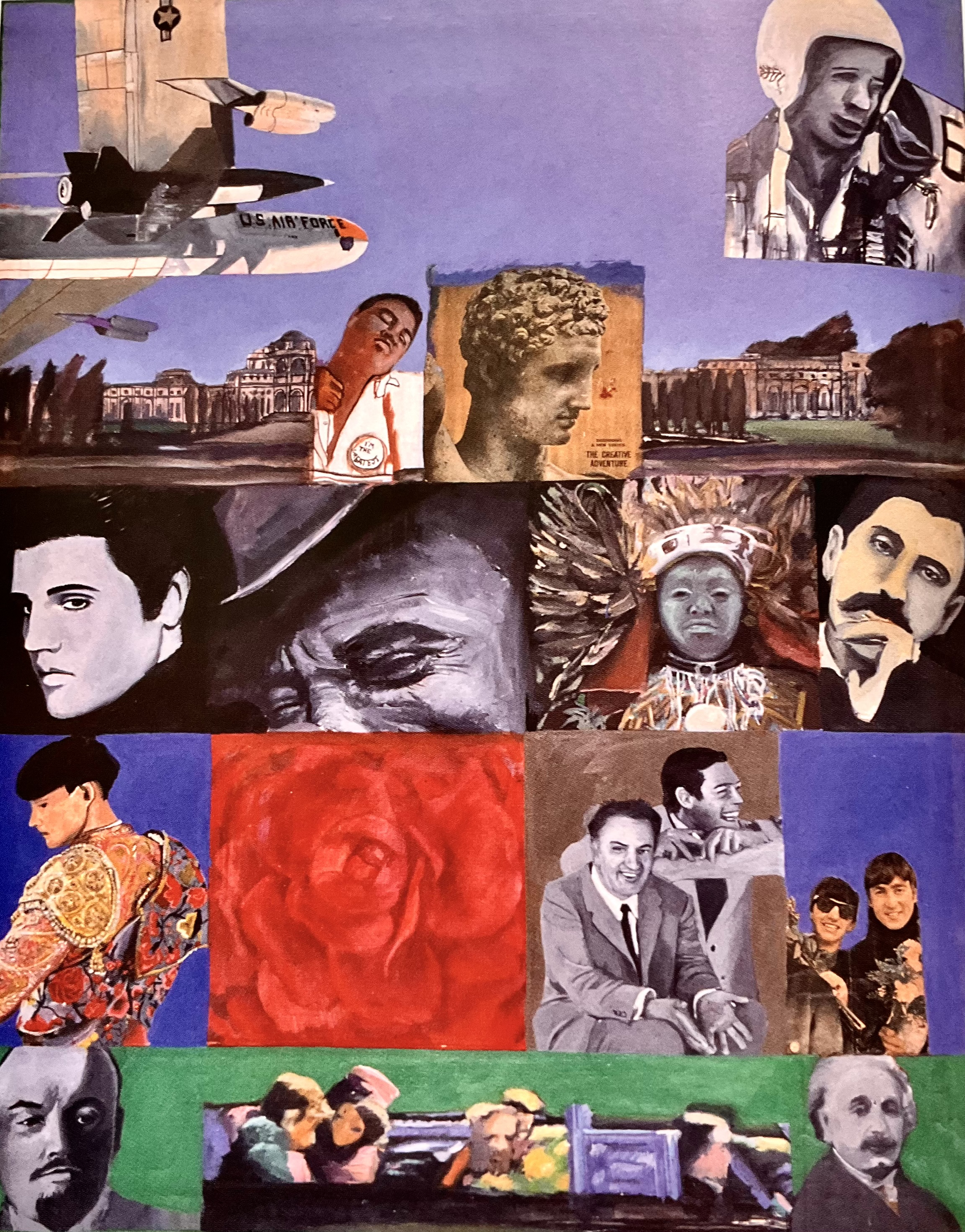
IT's a Man's World 1‘Pauline Boty - British Pop Art’s Sole Sister’, by Marc Kristal, published by Frances Lincoln, 2023

I had heard of Pauline Boty, seen ‘The Only Blonde in the World’ at Tate St Ives and met someone who was at the Royal College of Art at the same time  as ‘the Bardot of Wimbledon’
so to me this new book about her is very welcome  - telling so much about her and showing  so many paintings which were rescued some time after her untimely tragic demise soon after her daughter’s birth.
Pauline had cancer and chose to put off treatment until after her baby was safely born, thereby inviting her own death 1966, aged 28.

Marc Kristal’s narrative flows well and transports us back to the 1950’s, when young women were admitted to the Slade on the attractiveness of their selfies, their portfolios ignored.

Pauline is often referred to as beautiful but I think it was more the case that she had an appealing vitality.
She was able to get onto tv, being  interviewed by Alan Whicker, appear in a Ken Russell film, and take on stage acting. She was a presenter on a radio arts program, The Public Ear’ and sharply criticised the later work of Elvis Presley. She had a bit part in ‘Alfie’
Waldemar  Januscek, before he became the lovable commentator on past art, as an art critic called her a bad, derivative artist whose reputation rested on being a dolly bird.
The author is not sure he can defend her and says, ‘the artist and flibertygibbet began, increasingly, to merge.’
One of the strengths of the book is however that Kristal spoke to a range of Pauline Boty’s friends and family so we get a rounded picture of her from bubbly extrovert to troubled lonely person.
His harshest remark is that she was a narcissist ‘ for what is creating a motherless child if not the acme of self-centredness?’

Pauline Boty brought her experience  as a woman into her pop art, especially in her paintings ‘It’s a man’s world’. The first is an interesting collage of images of men plus a symbolic flower possibly referring to her sex. The second uses images of naked women a la Playboy. Bravely done perhaps and intending not to endorse the degradation  of women but I think you can’t be feminist by imitating what you deplore. Maybe Pauline was in two minds about feminism.

This is  certainly a lively contribution to our understanding of a little known artist and of the era in which she lived.