Friday, 20 June 2025

Arena TV program on Salgado -photographer.

 Salgado:the Spectre of Hope - Arena, bbc,  directed by Paul Carlin, 2001

This program was repeated in June 2025 because the Brazilian photographer Sebastiao


Salgado died in May aged 81.
It was preceded by an Omnibus showing his vibrant pictures of manual labour.
The Arena program shows Salgado ‘ in conversation’ with John Berger although it’s more that they speak in turn.
The photography is impressive and shows people from various locations forced by the vagaries of capitalism into becoming migrants, desperate to find security for themselves and their families. Salgado spent years researching,  meeting the people, editing to choose the most expressive and emotive photographs, and he speaks movingly in imperfect English with apparent sincerity.

What I don’t like about the program is everything that isn’t Salgado undiluted.
There’s woozy romantic sad music. There’s John Berger reading poetry and making obscure remarks. The movie camera zooms in on the images and shots are overlaid, emerging from this obscuring artiness when I want to view the still photographs calmly in their stillness as Salgado took them and printed them and selected them for his book. His aim is to make us aware of these migrations and to question the political and economic system that causes them.
He asserts that in this system only one in four people benefit.
The film maker intersperses movie shots and words from people about their plight.

There are unfortunately no statistical facts to back up this vision but it is powerfully convincing in its  repetitive relentless pictures of desperate looking refugees, beautifully captured in black and white.
Nor is there any political thought or theory about how to change capitalism. That’s left to us to undertake.

It’s great to learn about the photography of this committed man Sebastiao Salgado.
But it’s not helped by this Arena programme’s style and approach.

Gauguin -a new book about this artist and his time in Polynesia

 ‘ Gauguin and Polynesia ‘ by Nicholas Thomas, 2024

This book is written by someone who knows Polynesia and has researched his subject.
He considers the usual things said of Gauguin as a person that are very critical of his character, and looks at his paintings in detail. There are good reproductions that enable the reader to also do this.

Nicholas Thomas warns against taking the Somerset Maugham book ‘The Moon  and Sixpence’ as giving us any truth about Gauguin although he inspired it.

The questions of Gauguin’s  exploitation of young girls as sexual partners and of how far he gave a nostalgic romanticised  view of a French colony are addressed seriously.
It made me consider that my first instinctive responses to the paintings as enjoyable were worth something.
It doesn’t make Gauguin into a saint but it helps to reassesss his attitudes and it’s a fascinating read.

There is a copy in Cornwall County library, otherwise it costs £40.


Sunday, 18 May 2025

Trinity Buoy Wharf Drawing Exhibition at Falmouth Art Gallery May 2025

 I saw this in Falmouth, Cornwall, Uk in May 2025, but it has toured around the country and is an annual opportunity to submit work defined in any way as drawing.

Such variety - quite a lot of intricate pattern done for its own fascination.

There’s a catalogue to consult whilst there to find out more about each artist or you can buy one.

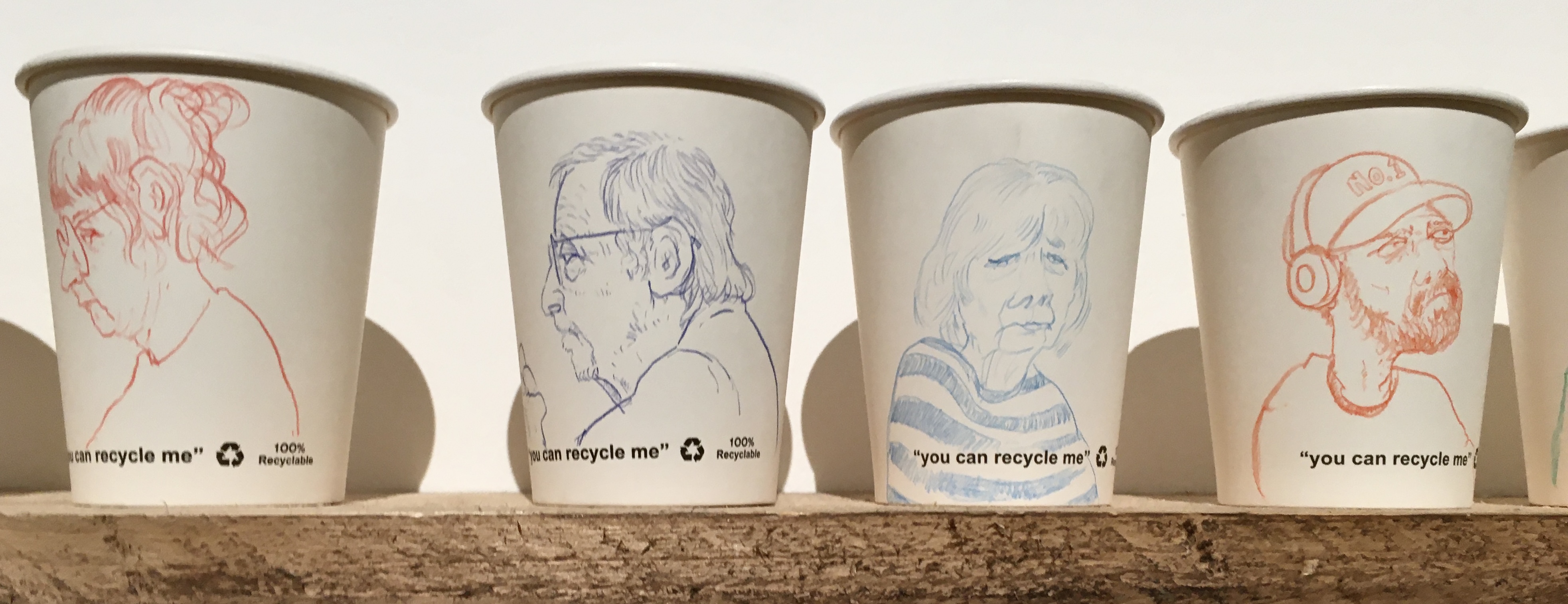
There is drawing on paper cups by Akash Byatt, a work made out of pencils arranged, Esteban Peña Parma, and the first prize winning wall of pottery vessel forms made out of steel wire by Max L Adam’s, each casting a shadow so ingenuity and unusual materials have been selected.


Then there are complex large works with social and political meanings like Simon Page’s ‘The End of Babel’ in  ink, and a big drawing evoking the huge space of ‘Kings’ Cross station’ in charcoal by Jeanette Barnes.


Marvellous portraits are there too - Jake Spicer’s ‘Esme’ in charcoal pencil and Roy Eastland’s silver point on gesso ‘Displaced Portrait’ from a series he made from found photos.

There is work to make you think, laugh, cry and feel moved to take up a drawing medium yourself.
Anyone can enter but most I look up have a long list of qualifications and exhibitions to show.

As I am leaving I find about 12 babies in nappies each with probably their mother, on a large mat, being introduced to the messy pleasures of paint. I’m so glad adult workshops aren’t held in public in our underwear, although it might give performance artists ideas. Most of the babies look completely bewildered.
However that’s not to say it’s not a pleasurable beginning to the possibilities of art.

And the drawing show in all its variety must stimulate a wide audience.


Artists' Book Fair at Exchange Penzance May 2025

 Jackie Chettur organised this artists’ book fair at Penzance’s Exchange gallery when they were between art shows. It was free to attend and the cafe was open for in my case a lukewarm hot chocolate that I was too impatient to have remade.

There were about 8 tables people had paid rent for and then two long tables with a selection sold with a small commission.

All sorts, from heavy volumes of images  and poetry to thin pamphlets made at home with a copier.

On the Friday evening there were various short talks. The first was virtually inaudible although I asked for them to speak louder, but things then improved.
Tina Kutter read moving details of how the situation of women in Afghanistan has deteriorated drastically since the Taliban took power.  She had these written on a scroll which was part of a group project, not for sale but presented in big red boxes to University librairies.

After a break Chloe confidently and amusingly performed a piece about the problems  using a copying machine.

Others spoke interestingly of their own groups or individual books. If there had been a printed list this would have helped audience members know names and titles and be able to google later.

There was a pleasant atmosphere of approachability so one could chat to artists and make contacts as well as handling the books.

Maybe more publicity could help but I hear attendance was particularly good on the Saturday.

It was good to display my own three books and sell one - actually ‘Carbon footprint and the last taboo’ which I had offered as a project to do at the Exchange originally but was not selected so I was pleased to get the resulting  books through the door and to sell one.

I also had two other books - ‘Drawn Here’ which Cornwall library has in stock, and ‘Women without’ about women suffering infertility, which was part of my MA work at Falmouth 2006.

Artists’ books are a specialist niche thing, well worth exploration.


Monday, 7 April 2025

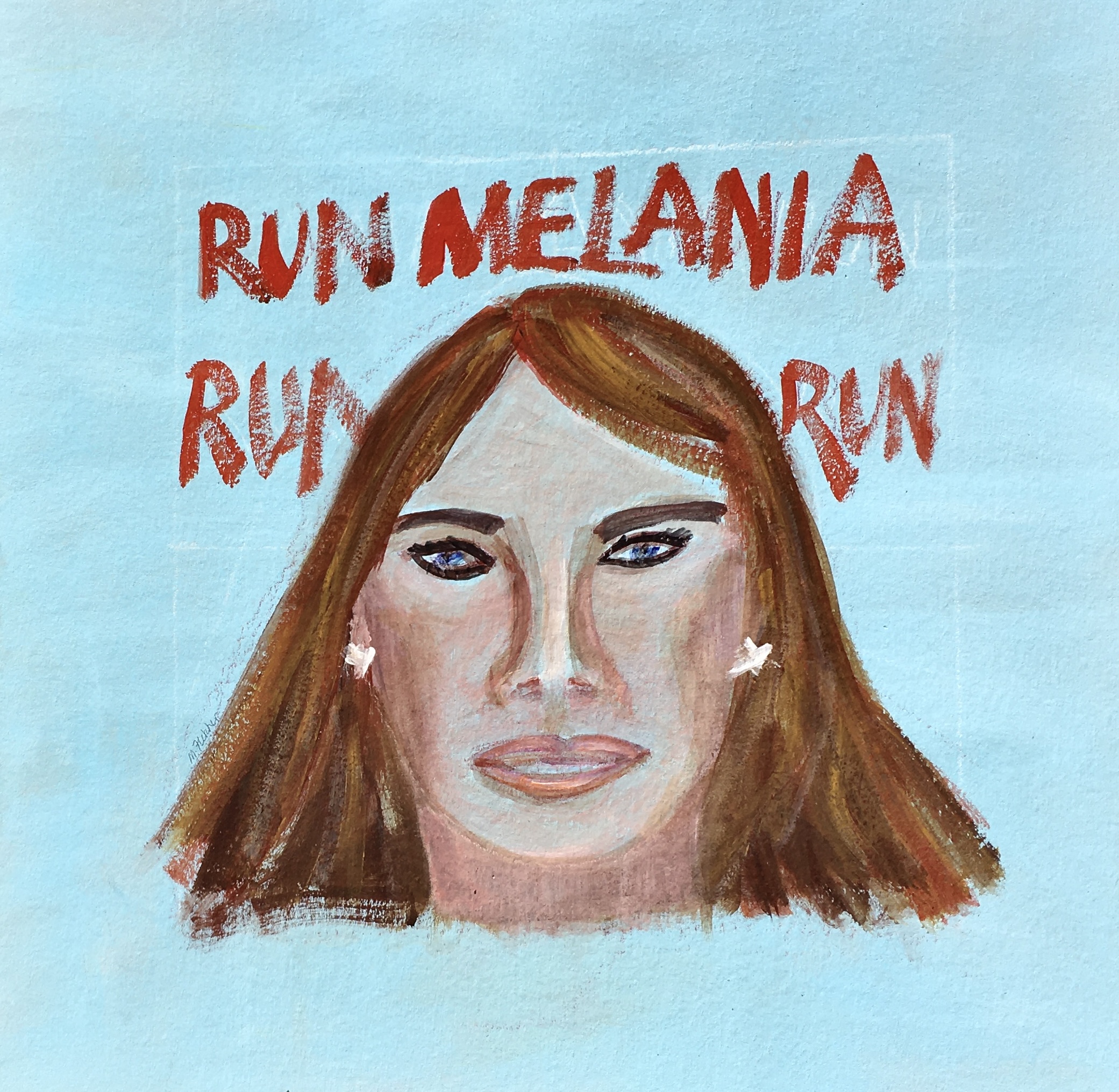
Run Melania Run

 I was moved by the present chaos to paint this  with two preparatory drawings, and to write the poem which is also a blues.  See https://vimeo.com/manage/videos/1075994014 or axisweeb.org/p/maryfletcher


Newlyn Society of Artists at Tremenheere April 2025

 'Longya' is the title of the new art exhibition by the Newlyn Society of Artists at Tremenheere until 21st April, 11-4.30, closed Mondays except Easter.

The title means ‘belonging’and was chosen by curator Dr Matt Retallick.

The trouble with having a title is that as a visitor I am expecting the work in the show to relate to it and as usual although some have been inspired to make relevant work, most have chosen work that is just what they normally do which fits the title very loosely.  Having the title makes me disgruntled when the work doesn’t fit it and wondering how the curator felt presented with this.


The most relevant item that strikes me is Janet McEwan’s and as she was there I tried my interpretation of her meaning - that Cornwall is something you have to believe in - and am delighted she likes that interpretation. There’s a photo of a woman receiving a holy communion  wafer with the white on black cross of the Cornish flag on it and a whole sweet jar of these nearby.

Karen Lorenz has made a lively short animated film showing aspects of the Morrab library in Penzance. 


Georgie Phipps has a sweet little porcelain matchbox to hold ‘Cornwall’s story’ rather than England’s Glory and a package addressed to a Cornish address, so cunningly made that I thought it was the actual brown paper item and it’s only when I read the list that I find it’s made of stoneware.


David Symonds has adapted his love of calendars and grids to document daily walks and found objects in a delightfully decorative way with small detailed labels to read that add another layer of interest.

Andrew Swan gives us one of his large sour political images showing how the Duchy and its state coach have been linked with the evils of slavery.

Mike Newton made an attractive portrait of Virginia Woolf, who visited St Ives and based ‘ To the Lighthouse’ on nearby Godrevy.

Then there are lots of landscape related pictures often depicted abstractly through shapes and marks.
 I liked Tim Ridley’s painting of Penzance’s Montol festival with its masked pagan figures, and Seamus Moran’s shovel with an unusable mesh spade, alluding to the past history of mining.

Sunday 13th there are talks by some of the artists 2-3-30, free as is the show, and you can park there.


Monday, 31 March 2025

Liberty Valance and Trump

 Liberty Valance and Trump 


I was watching ‘The man who shot Liberty Valance’ it’s from 1962, directed by John Ford.
It’s a good film with three archetypal male figures. John Wayne plays a strong silent type, good at fighting and shooting, and on the side of behaving well, passionate about a woman and desolate and angry but honourable when he loses her to James Stewart’s complex, educated more peaceful good man, not above helping out in the kitchen, who is brave and wins the love of the good and beautiful woman - Vera Miles. The third sort of man is Lee Marvin’s villainous violent criminal who bullies and ultimately fails.

I must have seen hundreds of westerns as I grew up. The heroes were always riding off into the sunset, uncommitted to any woman, strong, silent and good.
They were not  helpful models for a young woman longing to form a loving equal relationship with a man but they were good looking and wouldn’t hit a woman.
For a boy they endorsed bravery, self containment, honour and violence towards bad men if necessary. However they were definitely respectful of women and believers in justice.

There is a lot of talk now about boys growing up with no good role models, influenced by misogynist thugs, insecure about their gender, unheroic, lacking empathy and unable to make loving relationships.. Trump is the epitome of this cultural phenomenon, strangely admired by a third of American voters - they’d have voted for Liberty Valance and would  have sought to be protected by being his supporters, losing all self respect and honour.

And yet there aren’t any films that promote this bullying attitude are there?
There are online talks that do.  Internet availability provides a private access to the sort of men society as a whole largely fears and dislikes. Covid encouraged isolation from others.
There are few youth clubs in uk since the Tories demolished the youth service, which gave role models with whom young people met and talked, men who could be helpful to a growing teenager, especially those with absent fathers. Also they provided education about the traps and dangers of unknown lying people seeking power, especially online.

Young women via feminism are less subservient, more confident and less available. Men have to be careful about women’s rights and yet they see in some Muslim countries extremist misogyny triumphing. Bad men are recruiting followers.

People say that young people can’t concentrate on a whole film anyway or maybe not on a whole novel.
What’s to be done to promote the values most of us still want?
On tv everything becomes a competition, winners and losers - even bodies are on show for contestants to select, young farmers compete to get tenancy of national trust farms, antiques and houses are bought cheap and sold dear. Only the repair shop does kindly patient acts not for profit but milks our sympathy with endless tear-jerking  stories. Watercolour painting has to be judged with prizes. Cooking is highly competitive whether for bargain ingredients or at the level of master chefs.
At least no one can escape cooking knowledge one would think, and there used to be many programs showing education in childcare to manage bad behaviour in toddlers.
There’s nil political or economic education on tv- no examination in any depth of how different countries are organised, of views like Marxism or modern monetary theory.
A lot of bread and circuses- food and competitions although thankfully not the Roman proliferation of death and cruelty - that’s left for war zones in distant countries.

 Then there’s pornography - people objectified, sex without love. How did we go from a society with little knowledge of sex especially for women before marriage,  to one so desensitised and careless of feelings? Decadence accompanying the end of a civilisation.

And yet swing and roundabout wise we are more careful not to be racist and sexist in language.
You can be gay or change your gender in uk

Do young men, alonside young women,  need to be civilised via a counter culture of decency, equality, non violence and maturity?  Who is going to do it? Could the school curriculum cover it?
Instead of endless fruitless battles over the details of uniform, could we have an emphasis on cooperation and helpfulness?

The personal is political and cruelty is fascist. Workers of the world unite, men and women organising  together. We saw with the popularity of Jeremy Corbyn that there is a thirst for goodness, idealism, we see with protests about Gaza and climate  change -  maybe now even closer to home protests about benefit cuts, it’s not over, it’s not all lost and hope insists on action as the antidote to despair.