 ‘ Gauguin and Polynesia ‘ by Nicholas Thomas, 2024
This book is written by someone who knows Polynesia and has researched his subject.
He considers the usual things said of Gauguin as a person that are very critical of his character, and looks at his paintings in detail. There are good reproductions that enable the reader to also do this.
Nicholas Thomas warns against taking the Somerset Maugham book ‘The Moon and Sixpence’ as giving us any truth about Gauguin although he inspired it.
The questions of Gauguin’s exploitation of young girls as sexual partners and of how far he gave a nostalgic romanticised view of a French colony are addressed seriously.
It made me consider that my first instinctive responses to the paintings as enjoyable were worth something.
It doesn’t make Gauguin into a saint but it helps to reassesss his attitudes and it’s a fascinating read.
There is a copy in Cornwall County library, otherwise it costs £40.
Friday, 20 June 2025
Gauguin -a new book about this artist and his time in Polynesia

Sunday, 18 May 2025
Trinity Buoy Wharf Drawing Exhibition at Falmouth Art Gallery May 2025
I saw this in Falmouth, Cornwall, Uk in May 2025, but it has toured around the country and is an annual opportunity to submit work defined in any way as drawing.
Such variety - quite a lot of intricate pattern done for its own fascination.
There’s a catalogue to consult whilst there to find out more about each artist or you can buy one.
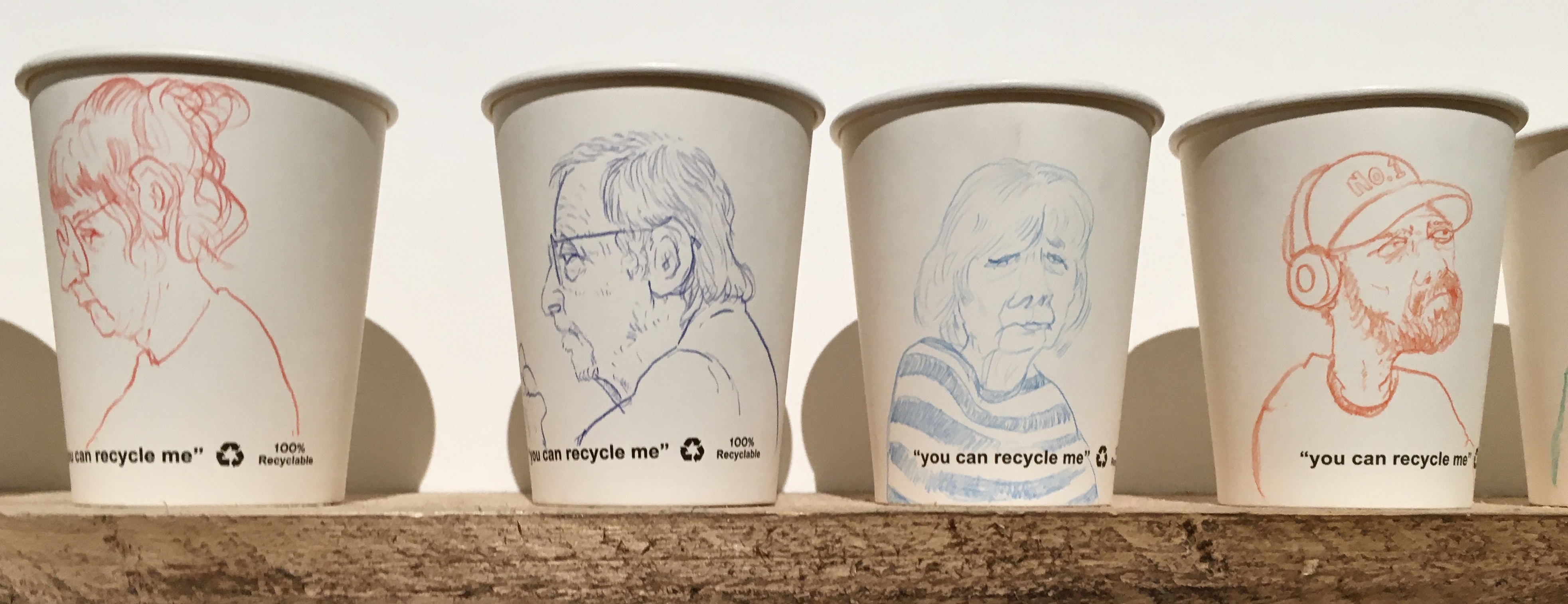
There is drawing on paper cups by Akash Byatt, a work made out of pencils arranged, Esteban Peña Parma, and the first prize winning wall of pottery vessel forms made out of steel wire by Max L Adam’s, each casting a shadow so ingenuity and unusual materials have been selected.


Then there are complex large works with social and political meanings like Simon Page’s ‘The End of Babel’ in ink, and a big drawing evoking the huge space of ‘Kings’ Cross station’ in charcoal by Jeanette Barnes.


Marvellous portraits are there too - Jake Spicer’s ‘Esme’ in charcoal pencil and Roy Eastland’s silver point on gesso ‘Displaced Portrait’ from a series he made from found photos.
There is work to make you think, laugh, cry and feel moved to take up a drawing medium yourself.
Anyone can enter but most I look up have a long list of qualifications and exhibitions to show.
As I am leaving I find about 12 babies in nappies each with probably their mother, on a large mat, being introduced to the messy pleasures of paint. I’m so glad adult workshops aren’t held in public in our underwear, although it might give performance artists ideas. Most of the babies look completely bewildered.
However that’s not to say it’s not a pleasurable beginning to the possibilities of art.
And the drawing show in all its variety must stimulate a wide audience.


Artists' Book Fair at Exchange Penzance May 2025
Jackie Chettur organised this artists’ book fair at Penzance’s Exchange gallery when they were between art shows. It was free to attend and the cafe was open for in my case a lukewarm hot chocolate that I was too impatient to have remade.
There were about 8 tables people had paid rent for and then two long tables with a selection sold with a small commission.
All sorts, from heavy volumes of images and poetry to thin pamphlets made at home with a copier.
On the Friday evening there were various short talks. The first was virtually inaudible although I asked for them to speak louder, but things then improved.
Tina Kutter read moving details of how the situation of women in Afghanistan has deteriorated drastically since the Taliban took power. She had these written on a scroll which was part of a group project, not for sale but presented in big red boxes to University librairies.
After a break Chloe confidently and amusingly performed a piece about the problems using a copying machine.
Others spoke interestingly of their own groups or individual books. If there had been a printed list this would have helped audience members know names and titles and be able to google later.
There was a pleasant atmosphere of approachability so one could chat to artists and make contacts as well as handling the books.
Maybe more publicity could help but I hear attendance was particularly good on the Saturday.
It was good to display my own three books and sell one - actually ‘Carbon footprint and the last taboo’ which I had offered as a project to do at the Exchange originally but was not selected so I was pleased to get the resulting books through the door and to sell one.
I also had two other books - ‘Drawn Here’ which Cornwall library has in stock, and ‘Women without’ about women suffering infertility, which was part of my MA work at Falmouth 2006.
Artists’ books are a specialist niche thing, well worth exploration.


Monday, 7 April 2025
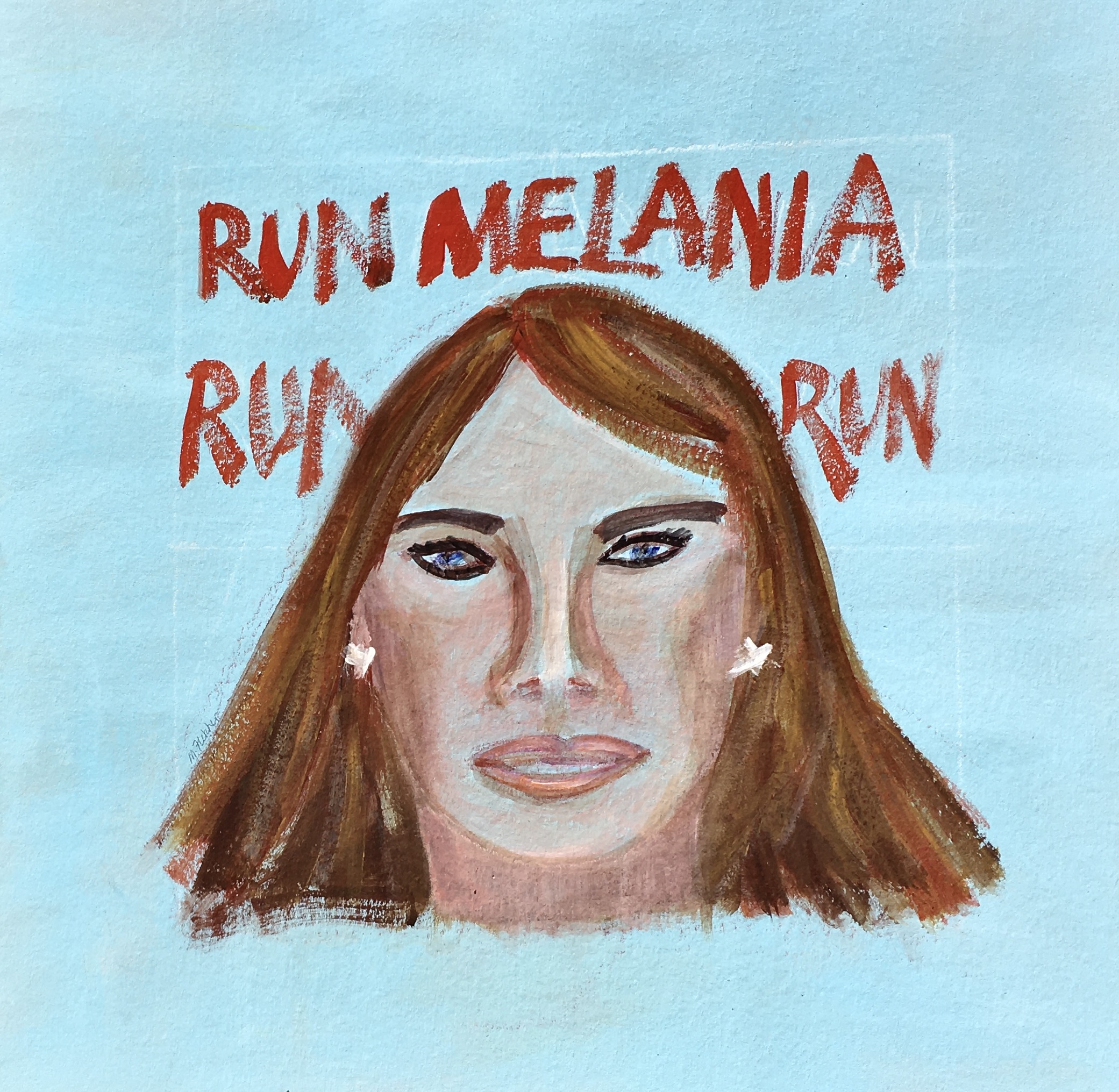
Run Melania Run
I was moved by the present chaos to paint this with two preparatory drawings, and to write the poem which is also a blues. See https://vimeo.com/manage/videos/1075994014 or axisweeb.org/p/maryfletcher

Newlyn Society of Artists at Tremenheere April 2025
'Longya' is the title of the new art exhibition by the Newlyn Society of Artists at Tremenheere until 21st April, 11-4.30, closed Mondays except Easter.
The title means ‘belonging’and was chosen by curator Dr Matt Retallick.
The trouble with having a title is that as a visitor I am expecting the work in the show to relate to it and as usual although some have been inspired to make relevant work, most have chosen work that is just what they normally do which fits the title very loosely. Having the title makes me disgruntled when the work doesn’t fit it and wondering how the curator felt presented with this.

The most relevant item that strikes me is Janet McEwan’s and as she was there I tried my interpretation of her meaning - that Cornwall is something you have to believe in - and am delighted she likes that interpretation. There’s a photo of a woman receiving a holy communion wafer with the white on black cross of the Cornish flag on it and a whole sweet jar of these nearby.
Karen Lorenz has made a lively short animated film showing aspects of the Morrab library in Penzance.

Georgie Phipps has a sweet little porcelain matchbox to hold ‘Cornwall’s story’ rather than England’s Glory and a package addressed to a Cornish address, so cunningly made that I thought it was the actual brown paper item and it’s only when I read the list that I find it’s made of stoneware.

David Symonds has adapted his love of calendars and grids to document daily walks and found objects in a delightfully decorative way with small detailed labels to read that add another layer of interest.
Andrew Swan gives us one of his large sour political images showing how the Duchy and its state coach have been linked with the evils of slavery.
Mike Newton made an attractive portrait of Virginia Woolf, who visited St Ives and based ‘ To the Lighthouse’ on nearby Godrevy.
Then there are lots of landscape related pictures often depicted abstractly through shapes and marks.
I liked Tim Ridley’s painting of Penzance’s Montol festival with its masked pagan figures, and Seamus Moran’s shovel with an unusable mesh spade, alluding to the past history of mining.
Sunday 13th there are talks by some of the artists 2-3-30, free as is the show, and you can park there.
Monday, 31 March 2025
Liberty Valance and Trump
Liberty Valance and Trump

I was watching ‘The man who shot Liberty Valance’ it’s from 1962, directed by John Ford.
It’s a good film with three archetypal male figures. John Wayne plays a strong silent type, good at fighting and shooting, and on the side of behaving well, passionate about a woman and desolate and angry but honourable when he loses her to James Stewart’s complex, educated more peaceful good man, not above helping out in the kitchen, who is brave and wins the love of the good and beautiful woman - Vera Miles. The third sort of man is Lee Marvin’s villainous violent criminal who bullies and ultimately fails.
I must have seen hundreds of westerns as I grew up. The heroes were always riding off into the sunset, uncommitted to any woman, strong, silent and good.
They were not helpful models for a young woman longing to form a loving equal relationship with a man but they were good looking and wouldn’t hit a woman.
For a boy they endorsed bravery, self containment, honour and violence towards bad men if necessary. However they were definitely respectful of women and believers in justice.
There is a lot of talk now about boys growing up with no good role models, influenced by misogynist thugs, insecure about their gender, unheroic, lacking empathy and unable to make loving relationships.. Trump is the epitome of this cultural phenomenon, strangely admired by a third of American voters - they’d have voted for Liberty Valance and would have sought to be protected by being his supporters, losing all self respect and honour.
And yet there aren’t any films that promote this bullying attitude are there?
There are online talks that do. Internet availability provides a private access to the sort of men society as a whole largely fears and dislikes. Covid encouraged isolation from others.
There are few youth clubs in uk since the Tories demolished the youth service, which gave role models with whom young people met and talked, men who could be helpful to a growing teenager, especially those with absent fathers. Also they provided education about the traps and dangers of unknown lying people seeking power, especially online.
Young women via feminism are less subservient, more confident and less available. Men have to be careful about women’s rights and yet they see in some Muslim countries extremist misogyny triumphing. Bad men are recruiting followers.
People say that young people can’t concentrate on a whole film anyway or maybe not on a whole novel.
What’s to be done to promote the values most of us still want?
On tv everything becomes a competition, winners and losers - even bodies are on show for contestants to select, young farmers compete to get tenancy of national trust farms, antiques and houses are bought cheap and sold dear. Only the repair shop does kindly patient acts not for profit but milks our sympathy with endless tear-jerking stories. Watercolour painting has to be judged with prizes. Cooking is highly competitive whether for bargain ingredients or at the level of master chefs.
At least no one can escape cooking knowledge one would think, and there used to be many programs showing education in childcare to manage bad behaviour in toddlers.
There’s nil political or economic education on tv- no examination in any depth of how different countries are organised, of views like Marxism or modern monetary theory.
A lot of bread and circuses- food and competitions although thankfully not the Roman proliferation of death and cruelty - that’s left for war zones in distant countries.
Then there’s pornography - people objectified, sex without love. How did we go from a society with little knowledge of sex especially for women before marriage, to one so desensitised and careless of feelings? Decadence accompanying the end of a civilisation.
And yet swing and roundabout wise we are more careful not to be racist and sexist in language.
You can be gay or change your gender in uk
Do young men, alonside young women, need to be civilised via a counter culture of decency, equality, non violence and maturity? Who is going to do it? Could the school curriculum cover it?
Instead of endless fruitless battles over the details of uniform, could we have an emphasis on cooperation and helpfulness?
The personal is political and cruelty is fascist. Workers of the world unite, men and women organising together. We saw with the popularity of Jeremy Corbyn that there is a thirst for goodness, idealism, we see with protests about Gaza and climate change - maybe now even closer to home protests about benefit cuts, it’s not over, it’s not all lost and hope insists on action as the antidote to despair.
Monday, 3 February 2025
Ithell Colquhoun 'Between Worlds' Tate St Ives Feb 1-May 5 2025
Ithell Colquhoun ‘ Between Worlds’ at Tate St Ives, Feb 1st - May 5 2025
Ithell Colquhoun - (‘Eye thell Cull hoon’ or ‘Ke’hoon’) was born in India to a white colonial family in 1908 but came to UK, attending the Slade art school, spending time in Paris and in Greece and eventually living in Cornwall with a studio in Lamorna, whilst having a second home in London.
She died 1988 and it’s since her work, left to the National Trust, was transferred to Tate 2019 that it has excited new interest.
This artist was wealthy enough to pursue her eccentricities in many directions through multiple esoteric occult connections which made her unwelcome to continue in the official British Surrealist movement. She became one of the lesbian contingent in Lamorna alongside Gluck and Marlow Moss.
Her writing has been described as ‘overwrought and opaque ‘ and my own brief attempt to read some of it leads me to think she was rather batty.
She pursued beliefs in a divine presence with hermaphrodite origins and sought a utopian future, whilst apparently mentioning racist ideas and peculiar views on incest which I have only heard hinted at rather than frankly explained by Dr Amy Hale on YouTube.
So what of this extensive show greeted by a huge buzzing crowd at the Private View?
And why are no parallels mentioned with Jung?

Judith showing the head of Holofernes, 1929
The exhibition begins with more academic work, then interest in nature, images about same sex attraction, surreal compositions, structures based on cubes, responses to Penwith’s Celtic past and stone circles in the landscape and ending with abstract colourful tarot cards which were intended not for fortune telling but for meditation.
At her best Ithell’s images are vivid and memorable - but in this show there is some repetitious stuff like the many tiny collages that I doubt she would have chosen to exhibit and some of which are too high on the wall for me to see.
Sometimes her paint is clumsily applied as she seeks to express her ideas no doubt not thinking of anything but how to explore as she feels the need for self- enquiry and esoteric speculation.
It’s miles from the interest in applying paint with lively panache that continues a few yards away at the Penwith gallery to this day in St Ives. There the committee prefers abstract chutzpah and visual celebration to the intense preoccupation of spiritual enquiry we see in Colquhoun’s surreal world.
Both are narrow spheres with little of naturalist observation or political and social relevance although one of Colquhoun’s pictures references a communist liberation group in 1942 in Greece that were fired on by the British forces.
I found myself getting absorbed by it all much more on my second visit when the gallery was quiet. I noticed how very strange were her early paintings and how much vaginal imagery was in the later work, which is actually around the time when Judy Chicago used this in her controversial ‘Dinner Party.’
Local folk may be glad to find an artist exhibited in Tate St Ives who lived in Penwith rather than visiting briefly. This particular one fits well with the idea of our area being one with a lot of flakey practices linked with romantic spiritual or magical myth.
Tate presents the show with no parallel examples from other artists but a separate room of work by Bharti Kher who has some similarities.
If you like an immersion into one woman’s strange ideas you may really enjoy it.

Drawing for 'The Sunset birth, 1942

Ther Sunset Birth, 1942

E.L.A.S. Peoples'Army for National Liberation 1942

Leave uncombed your darling hair 1953

Tarot cards

from slide show of later works.