| |
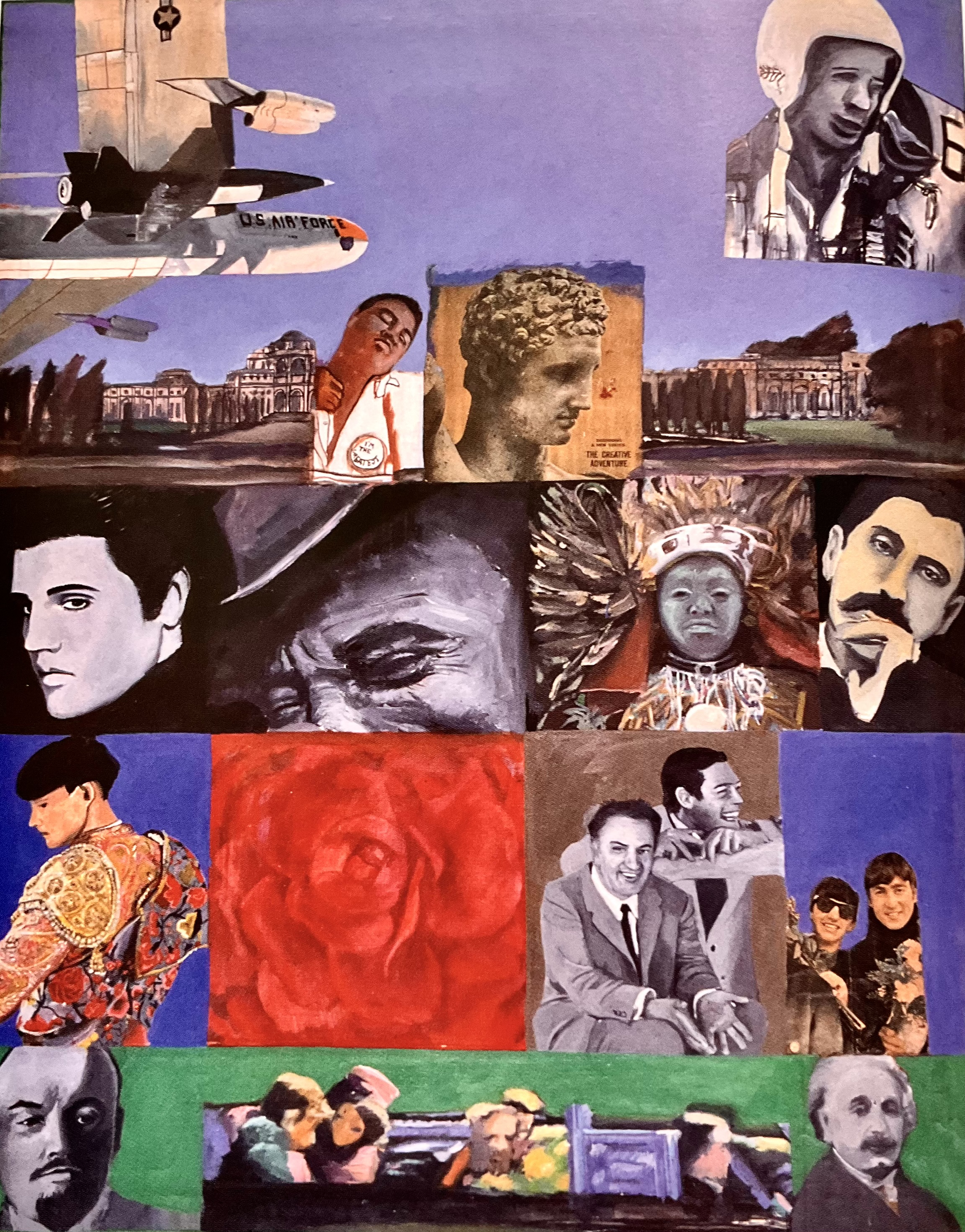
| IT's a Man's World 1 | ‘Pauline Boty - British Pop Art’s Sole Sister’, by Marc Kristal, published by Frances Lincoln, 2023 I had heard of Pauline Boty, seen ‘The Only Blonde in the World’ at Tate St Ives and met someone who was at the Royal College of Art at the same time as ‘the Bardot of Wimbledon’ so to me this new book about her is very welcome - telling so much about her and showing so many paintings which were rescued some time after her untimely tragic demise soon after her daughter’s birth. Pauline had cancer and chose to put off treatment until after her baby was safely born, thereby inviting her own death 1966, aged 28. Marc Kristal’s narrative flows well and transports us back to the 1950’s, when young women were admitted to the Slade on the attractiveness of their selfies, their portfolios ignored. Pauline is often referred to as beautiful but I think it was more the case that she had an appealing vitality. She was able to get onto tv, being interviewed by Alan Whicker, appear in a Ken Russell film, and take on stage acting. She was a presenter on a radio arts program, The Public Ear’ and sharply criticised the later work of Elvis Presley. She had a bit part in ‘Alfie’ Waldemar Januscek, before he became the lovable commentator on past art, as an art critic called her a bad, derivative artist whose reputation rested on being a dolly bird. The author is not sure he can defend her and says, ‘the artist and flibertygibbet began, increasingly, to merge.’ One of the strengths of the book is however that Kristal spoke to a range of Pauline Boty’s friends and family so we get a rounded picture of her from bubbly extrovert to troubled lonely person. His harshest remark is that she was a narcissist ‘ for what is creating a motherless child if not the acme of self-centredness?’ Pauline Boty brought her experience as a woman into her pop art, especially in her paintings ‘It’s a man’s world’. The first is an interesting collage of images of men plus a symbolic flower possibly referring to her sex. The second uses images of naked women a la Playboy. Bravely done perhaps and intending not to endorse the degradation of women but I think you can’t be feminist by imitating what you deplore. Maybe Pauline was in two minds about feminism. This is certainly a lively contribution to our understanding of a little known artist and of the era in which she lived. |
As we only had a week it would not be possible for an independent reviewer to get anything in the press in time. I suppose if we could find a writer willing to write about it we could put it on social media and that would be very welcome, If anyone would volunteer to do that next time please get in touch.
So,despite my bias to liking my own group’s show, I thought I would write something.
It’s rather a mystery why some work sells better but it seems naturalistic scenes well observed and carried out with panache are again the most popular - Sharon Reeves and Clare Hughes being cited. This time Sharon sold 3 paintings off the wall of sand dunes and their grasses.
However, to quote Schnabel, ‘ You make the paintings not to sell them. You make the paintings to see them.’
So the more abstract- Pat Wilson Smith, Tracy Flett, were as usual less commercial although all the artists have people who appreciate them and often can only afford cards.
There were interesting and unusual ceramics by myself and Pat.
Then Caroline Marwood had very unusual experimental works combining photos and collaged elements and digital designs based on local observations of landscape.
Kate Cameron had expressionist verve in her intensely coloured works, some set in Spain.
Kerry Grant showed delicate close ups of observed nature in watercolour and other media, emphasising pattern and design.
I had a mix as usual of some more expressionist observations or memories of musicians and some political more conceptual items.
So a good wide range of approaches and you would think something for everyone but there is a limited number of visitors to the show able to buy anything large.
Maybe a campaign could begin to encourage folk to decorate their walls with original art.
I hear some strange people have blank walks and others buy reproductions that attract them and have the seal of being approved by history or by marketing managers.
Artists other than the Big Names do not make much profit and really love to get their pictures out into the world.
Personally I fear when I die my family will throw it all away.
Incidentally Yoko Ono had a show called ‘Big Names’ which consisted of just that - huge names of celebrated artists being carried into a gallery.
Please come and see our next shows in 2024 - to be arranged- and please bring your cash or
credit card - the small purchases not only add up but are very encouraging.
We have all sold more paintings than Van Gogh did in his lifetime- he sold ONE - which seems very odd when his brother was an art dealer. If it had not been for his sister- in -law after the brother died, those works might have sunk without trace.
At least ours are on the internet and Taking Space have a website to Google.

This book has an ugly image of a woman on the cover, by Genieve Figgis and lots of off puttingly gross art by feminists is referenced, often in some detail, involving performances or film with use of blood, sexual acts and references to disease. Often the artists break boundaries in ways that make their work difficult to see or even read about.
Lauren Elkin writes unconventionally, at times bringing in her own experiences such as giving birth and creatively jumping around her choices as she seeks women who try to make a new feminist language rather than simply reacting against patriarchy.
Some examples are well known, Elkin adding interesting detail, and many are new to me, necessitating my own research online as there are very few photographs in the book.
She keeps returning to the ‘Three Guineas’ essay of Virginia Woolf and I think unconvincingly presents her sister Vanessa Bell as avant guardedly feminist, whilst not mentioning that she had remarkably done an entirely abstract painting in 1914 which is in Tate’s collection.
I am firmly on the side that you can’t advance feminism by choosing to show women in abject degradation but Elkin is now ready to defend the pornographic efforts of Kathy Acker and others.
She mentions philosophers such as Cixous and Kristeva but without explaining much about them.<\p>
I learnt new things, considered the author’s views and watched some Schneeman film from the seventies that at eight minutes felt very long.
This new contribution to womens’ art history is welcome, well referenced, and gives us Elkin’s personal take on feminist works involving women’s bodies.


‘The Casablanca Art School’. Tate St Ives, May 27th to January 14th 2024, and in Sharjah Art Foundation, United Arab Emirates, from February 2024
This show at first viewing struck me as very colourful and reminded me of seventies hard edge painting in UK
 | ||||||
| Mohamed Melehi 1969 |
It seems, free of French colonial rule at last 1956, Casablanca Art School developed to follow the prevailing western style.
I was a bit disappointed, expecting something more different from the 22 artists I had never encountered before.
It was the brown more political and savage pieces by Farid Bekahia, 1961, about torture under the French regime and the spirit of revolutionary victory in Cuba that attracted me.
 | ||||||||
| Farid Belkahia Torutres, 1961-2 |
 | |||||||||||||
| Farid Bekahia, Cuba SI, 1961 |
Coming back to see it all again I slowed down to read the captions and view the slide shows. This showed me that a lot of art was placed in the streets on the walls.

There’s a photo of students irreverently accessorising a classical statue - their studies now turning to the local design of jewelry, carpets etc.

 | |||||
| Melehi's notebook |
Astonishing facts are found in the wall texts but not highlighted in any way.
In colonial times classes at the art school had been divided not just by gender but by social class.
One of the female artists, Chaibia Tallal had been forced to marry at a very young age, but this I found out from chatting to an attendant, its not in the captions.
 | ||
| Chaibia Tallal , Marriage Ceremony, 1983 |
Two teachers of graphic design were imprisoned for Marxist tendencies for 6 and 8 years by the new Moroccan rulers but this is a brief reference which I would have liked to learn more about.
There are some poster designs that feature Palestine but the show does not enlighten us about these.