Tuesday, 24 November 2015

CMR, Redruth-Digital Film Installation alongside Cornwall Film Festival

CMR. Digital film installation alongside Cornwall Film Festival. Saturday Nov 14th 2015

As far as I know CMR got involved to put this on at short notice because of a contact Cat Bagg had with Cinestar at Back Lane West. She and Alice Mahoney acted speedily to get this going and some of us put work in, installed all round the building in Redruth, which is conveniently near the cinema where Cornwall Film Festival was happening that weekend. Stuart Blackmore was technical backup. 
I managed to get a poster put up inside the cinema just where people were passing to go into the films and I decided to add all our names to it as contributors to try to interest more people.
Attendance wasn't high, it was bad weather, but a lot of those going to the analogue originated films at Back Lane West probably came to it.
There was a nice spirit of helping together at the installation and feeling it had been a good idea at the end of the day drinks. Redruth closes early, most shops were shut at 4pm, it was dark and almost deserted, four saffron buns for a pound at Warren's, and they go outside and shout this to the few people passing.

Cat Bagg, Alice Mahoney, Jonathan Hayter, Claire Stockings-Baker, Frances Walsh, Fred McVittie, David Axtell, 
Morwenna Morrison and myself took part.

Alice chose my 'Art Notes' from what I offered. It's a satirical piece about trying to make a mark as an artist and the sound, a song, is essential to it. I saw someone using the headphones and laughing so I was pleased. It can be seen on my Vimeo page, 1min 46.


This brings me to a point that I like the length of films to be posted so I can decide whether to embark on them. I also like a notice about them posted by them and only some of the work had this, otherwise there were notes in a handout but only three copies of it. The notes were very interesting and illuminating.


On the same floor Fred McVittie had a piece which a young man told me he was very confused about. I asked if he was an artist and he said no, he was a media studies student, which seemed a bit sad to me to differentiate between the two. Fred's blurb referred to graffiti and protest art and the film, rather strange and menacing perhaps embodied I thought frustrated rage and alienation.


Alice Mahoney's 'feast' was really a metaphor about consumption, a rather grotesque meal slowed down.


Jonathan Hayter showed experimental colourful imaginatively made forms, with music by David Handford, and strobe lights.


Claire Baker's video was projected in one of the rooms and made an impact as a lone adolescent girl wandered in a stark landscape, rather poetic and moody, a sublime contrast to Fred's figure emerging in a lonely landscape, and my person in an urban cul-de-sac.


Downstairs Cat Bagg had work using standing stones that were seen in a whirling around inventive way inside circular vignettes with a pattern of lights on the floor. She explained to me some of the complexity of working out how this was done to fit the space.


David Axtell had a brooding sunset behind a structure of Tibetan flags on a sea edge cliff and went alongside a poem about loss and war by Laurence Binyon.


Frances Walsh showed 'Lighting a fire' , a beautifully filmed piece with clear colours and subtle sounds in which the artist collaborated with her young son.


Morwenna Morrison also used a room to install her piece, which had a lovely old armchair for viewing and getting into the mood of her montaged shots from old footage about marriage, which cast rather a jaundiced and wry comment on the institution and is part of her focus on nostalgia in her work.


As usual a very mixed bag, easy to move amongst and take in as the visitor felt inclined.
This was in contrast to the Cinestar films at Back Lane West, which had the advantage of being seen from start to finish but the disadvantage that the rolling programme leaves a viewer stuck in experiences they may tire of because they are not to their taste. Some of it was very fuzzy, some abstract experiments that were a bit long for me. Also it was even colder than CMR and with only a hard box to sit on whereas up the road we did have a few chairs.

Meanwhile the festival was at the  proper cinema, this year warm enough thank goodness. It's quite expensive to go to things, it's reduced in scope, little publicity, no Cornish films, no artist-made experimental section now and I regret none of the cameraderie I  felt when it was all in Falmouth Poly or Princess Pavilions and one got into conversation and film making and film makers felt like a wonderful group of colleagues. There was more of that at CMR's impromptu drinks.

I saw at the cinema the films from Falmouth media program, and the room was packed with new students from the course. Oddly only three films were chosen to be screened and although they had some interest for me, some good acting, some novel ideas, the overall impression made on me was that all the students would be thinking they would do much better themselves.

This was followed by ' Taxi Tehran'  by Jafar Panahi , winner of the Golden Bear at Berlin Film Festival  this year, which I loved. It was ingenious, brave, funny and moving and so apt on the day after the Paris atrocities to see a film maker persisting in expressing himself within the oppressive regime of Iran, where he has been forbidden from making films and I read that one of his works was smuggled out to to Europe on a data stick hidden in a cake. I started to applaud and after a moment others joined in. It's the sort of thing that can happen at a festival showing.


So, from a completely realised drama about the most important things in life to experimental scratching on celluloid. An amazing day of contrasts.


Wednesday, 28 October 2015

Soil Culture:Deep Roots, Falmouth Art Gallery Sept 9 to Nov 21, 2015

'Soil Culture:Deep Roots' Falmouth art gallery Sept 9 to Nov 21 2015. 

This exhibition is celebrating the UN year of soils and will be touring to Plymouth University Jan to March 2016. 

An important subject, but does it make an enthralling exhibition? 

It's unusual to see such world famous artists as Ana Mendieta in Falmouth and I was hoping maybe for too much as I entered the gallery. 

Ana Mendieta
Ana Mendieta

Ana Mendieta's work stands out because she involved herself, specifically her own body in filmed performances in which her naked form is seen , here emerging from under stones and earth, or the space where it has been, set alight with bright flames, or left as an impression. A book available to read in the gallery is helpful in telling her story and explaining her wish to somehow enact personal rituals to be in touch with Mother Earth as if longing for a prehistoric awareness of it. It's intensely romantic to my mind, and as she died in a tragic accident at a young age the story of that incident and her husband, artist Carl Andre being accused of murder and acquitted, the vivid tragedy threatens to impede serious consideration of her art. However in this show it is the most attention grabbing and dramatic piece and nicely shown with a comfortable and beautifully crafted wooden seat opposite the three small screens. Also helpfully the time of the video is given so you know how long you might take to receive the images, which are only about three minutes and seen simultaneously.

 Suzanne Williams also uses video and contributes a page of poetic explanation but it's all too 'magical' for my liking, and it's not clear how long the video is so I did not take the time to do it justice. 

In another corner Daro Montag has a video of a circular agglomeration of writhing worms that he somehow attracted to a spot to film and I overheard a visitor saying they could watch it for hours. His work depends on getting nature to make it and he also shows a piece of film, buried in the earth and now illuminated to show how soil microbes ate away at it and produced coloured marks. 


Daro Montag
Daro Montag

Elsewhere several artists use earth to make marks and they are all using grid form to present them, rectangles by Herman de Vries, spots by Sandra Masterson, Richard Long's thumb prints, all making repeat patterns. The colours are earth colours, the excuse for the work is the soil idea but the results are pure abstract pattern making.

Herman de Vries


Sandra Masterson

Richard Long


Mel Chin

Paolo Barrile

Some ideas I really warm to, clearing a field of contaminating chemicals, by Mel Chin, shown us via an ancient looking beautifully drawn diagram, and Paolo Barrile's sweet little bottles of soil are very attractive and linked to a long project also about pollution. The ideas are important and the carrying out of them but the chart and the tin bottles seem like charming souvenirs of that. 

Adam White has an attractive watercolour map of geology of the British Isles but can't resist a whimsical jokey key of nonsense he has made up that infuriates me. 
Adam White

Claire Pentecost has a large collection of large earth ingots and drawings with all sorts of references that rather timidly hint at the evils of capitalism. 

Claire Pentecost

David Nash exchanged turf from Wales and Kensington to see what grew. 
David Nash

Andy Goldsworthy shows a lovely exuberant drawing for an earth work that he has made. 
Andy Goldsworthy

Matt Robinson piles up mud bricks from a building being made in Cornwall. They are being carefully maintained to not dry out which makes me wonder how they will fare in the inter faith Building, where I believe they will be indoors. 

Matt Robinson

That's a brief whizz round it.  It's unsatisfying somehow.  Certainly it rises awareness of soil, makes us think about it, but it's mostly a bit dry, not watered by liveliness, it needs a lot of work reading the blurb. It shows how difficult it is to make vibrant art about soil or with it and how strong is the urge to organise in grids. 

There's Ana Mendieta exhibiting her body and impressions she made with it and did things to, making a spectacle of herself, and Daro Montag, exhibiting ingenious images he induced natural living organisms to make, keeping his body out of it. 

I imagine Mendieta in a sort of sensationalist tv series getting the worms to squirm on her naked body, why the nakedness, impulse to shock, the only way she could get attention? Carl Andre , her husband , getting attention by coolly arranging bricks in a grid- bricks, mud, earth, fire, would be interesting to see them also here. 

Combine the body impression in the earth with the presumably used worm food to get worms all over the body impression? Then it's sort of Hamlet, death, transience? That's my concept, Mendieta plus Montag. 

I did buy my first copy of 'Resurgence' ecology magazine to read later, and I am still turning 'Soil' over with my mental spade.


anonymous experiments with materials provided

Tuesday, 5 May 2015

Bedroom Tax and other Political art

CMR Redruth, 'Bedroom Tax and other political art' .


This was a pop up exhibition which I proposed and it took place over a weekend 17-19th April, 2015, just before the General Election.

I had hoped for several members to contribute from the cmr collective but only three did so, Alice Mahoney, Fred McVittie and David Axtell.

Also I tried to obtain contributions from contacts I had and via Krowji,a  studio complex nearby, whose ' Outhere 'opportunities are online , and via Axisweb opportunities.
Here again only five contributions, poems, photos, an email letter, a drawing and a one to one case history were received, but these each gave something of interest.
The case history was particularly valuable as it showed the stages by which a previously happily housed woman came to be a homeless sofa surfer because of the introduction of the Bedroom  Tax, brought in by the Tory/LibDem government, hopefully to be abolished by Labour if they form the next government.

David Axtell is an artist and illustrator from Wadebridge who exhibits in Cornwall. Working on this theme was an opportunity to experiment which he seized eagerly, throwing himself into it with a wealth of ideas and making two rooms of installation, elegantly arranged , using all sorts of objects.
part of the installation

David Axtell

Richard Third's re-burial

The Shard
He could explain all the diverse connections that lead to these results, comparisons of the expense of the Shard building in London, the cost of the re burial of King Richard third, with the existence of food banks, shown via his own apple food bank where one could take fruit to eat, some evocative poems, a metal bedstead part, a ring of red painted pennies etc. A visitor I felt could only get some of the references but because the rooms were intriguing and attractive could be lead into thinking about the subjects referenced, such as disability benefit problems, and helped by reading information that was displayed, not overloading the show with reading matter but providing a context. David Axtell was there to explain where this was invited.

Alice Mahoney had put up a row of low resolution photos of empty rooms which were not explained although their dimensions were given.

Upstairs Fred McVittie contributed a video of himself exclaiming angrily and at increasingly slower motion about the all pervasive coverage of the Royal Wedding, which went well next to my picture of a glamourous crown with words beneath, not at first noticeable, saying ,'but I would prefer a Republic' I added to this a  book about the wealth of the Windsors and a communication from the organisation 'Republic'.

My room about the bedroom tax  contained a lot of information which visitors could sit at a desk and examine. I also had three things to watch on a TV monitor, my own version of 'The Money Trick' based on Tressell's  'the ragged trousered philanthropists', a Glasgow anti Bedroom Tax protest song used in rallies, and as an incongruous contrast, a n amusing clip from 'Mr Blandings Dream House' where Mirna Loy tells a workman at length what colours she wants the painter to use in the rooms.


I had as the main focus three paintings contrasting Van Gogh, an immigrant who never held down a job and existed thanks to the financial support of his brother, selling only one painting in his lifetime and suffering from mental illness, with David Cameron, PM, who has a second home, a spare house. It was because Gauguin was going to stay in Vincent's spare room that he painted the Sunflower paintings which we all know and which have been sold so expensively since his death. I would argue Van Gogh's contribution to society was immense, but one our prime minister would have dismissed  as not that of a hard working achiever.


Added to this was Virginia Woolf's comments on the need for a woman to have a room of her own in which to write,with a picture of her study, a drawing of someone's ideal spare room, the bedroom tax case history with illustrations I added, my childhood bedroom, three sculptures to do with a nightmare of the difficulties of the bedroom tax, eviction and houses as a lottery. I added the other contributions and some images I had made in1980 about the government advice in the event of
Nuclear war to 'protect and survive' by making a shelter in the house.
V.Woolf's study

Nightmare about the Bedroom Tax

Housing Lottery


I wanted the result to be visually interesting and the information to be available rather than overwhelming.


Because other contributions were few, I had the opportunity to exhibit other political works I  had, about union leader Bob Crow, the presence of armed police on Paddington Station, the St.Paul's 'Occupy' protest,


the image of women in burkhas, and the annual slaughter of 104 women in 2012 in UK by their partners or ex partners, and a joke painting about Obama and Merkel talking, with an eavesdropper round the corner of the canvas, based on a news item, and also a joke about painters who paint round the corner of the canvas.

I put 'Neighbours' just outside the Bedroom room, a painting about my painful experience of hearing a neighbour abusing her children verbally and having to decide what to do about it.
I included work about Umanets who I considered unfairly imprisoned for scribbling on a Rothko and I included remarks made by those who signed my petition, which did not succeed, including one of Pussy Riot Russian protest artists, and an article in which Umanets says he was wrong to deface the Rothko.
Umanets imprisoned in Rothko

I had various quotations from people about rooms put in odd spaces and charts about housing, room sizes, the political parties' policies etc. I had a painted banner I did for the Labour Party to use about the nhs and a photo of me in our front room where I did it and a form for the artists Union membership.

So, there was quite a lot of painting upstairs and video which contrasted with the room installations on the floor below.

There were 31 visitors and many stayed over an hour and started discussions on politics and art.

I went into Redruth's main pedestrian street round the corner and invited twenty people to visit the show. Of these two came in. The woman returned saying I did not look like the sort of person to do that sort of work, I looked too sweet. However she approved of the show and its politics.
The man turned out to be a performance poet who gave us some oral poetry on the spot, and tragically my capturing of one on video failed as I pressed the button twice and only got the images from it swinging from my wrist and me exclaiming , 'wow,that was good' maybe Terry Clemo can be persuaded to perform again? but so far my email is sadly unanswered.

All this, the hanging of the show, the invigilation and the taking down was a lot to do for one weekend.
I found it exhausting and without my husband Pedyr  Prior's invaluable help and tremendous patience it would not have happened.

Those involved felt it was worthwhile and there were a lot of positive comments made. The audience was small but really looking, really interested.

A couple of artists told me they would have liked to contribute when they saw the show.

It was marvellous to be ble to show what I wanted and to give others space also, to be in a place where you can tack a drawing unframed on the wall.
Despite the local library not allowing me to collect interviews or leave my fliers, despite having to resist the watering down of the political title of the show suggested by a member of cmr and the removal of its advertising  from a group's website where I am a member because folk were nervous of being seen as political, I had good publicity in the local paper and got listed in the Guardian guide and interviewed on the local 'funkin art ' radio station.

Hopefully I can reach a further audience through this blog.

There are a lot of criticisms made of political art, that it's too strident, too obvious, too transient, too propagandist. It ranges from literal photos and reportage to surreal constructions, from party policy to personal reverie,
Some people want to do it because politics is important to them and I am one of them.
You can say that all art is political, the choice to only do pretty pictures that sell, shocking images that are reported widely, etc. is a choice, politics is people influencing others.
When I saw the mosaics and statues glorifying the workers in the Soviet Moscow underground their messages were clear, but on my return to London I realised the coca cola ads in Piccadilly were our own capitalist propaganda.

I feel that our era of art is decadent, artists are sensation seeking, often unwilling to take a stand, leaving everything open to interpretation as if nothing really matters, often with an aesthetic of emptiness, nothingness, vacuity.
I do not want my own art to acquiesce in this and I seek to communicate clearly and be heard as well as seen.


Monday, 24 November 2014

' Misbehaviour ' at cmr gallery Redruth October 2014

'Misbehaviour' exhibition organised and curated by Katya Rosenburg at CMR Redruth - an Artist collective.
October  2014, Wednesday  to Saturday  12-4, free admission.
Members of CMR invigilated.

There was a lot to see in this show, work from 50 artists, from several countries, which is going onto be shown in London.

I felt quite at home looking at it as I am familiar with themed  political work from the 80's when I was part of Brixton Womens' Work shows. There was a mix of printed booklets, video, participatory stuff and purely visual and there were helpful statements from the artists about their contributions. 
I 'd have liked some work hung lower, some statements to make more sense, some information about the Artists and a printed list of them to take away, but in general it looked good, well spaced, easy to get involved for at least an hour and thought provoking. Someone visiting remarked how you see nothing like this in St.Ives, still dominated by what I call 'Penwithy abstraction', it's an invigorating change to be asked to think and for the artists to be involved in current issues such as the London riots.

Amanda Walsh, from Redruth, had obtained cc tv footage of misbehaving, to understate it, which was shown on a large screen, showing bluish video of night scenes of fighting amongst presumably drunken people in our streets and police dealing with the victims of it. There was some middle of the road bangy music which you could have on the headphones and which may help people to keep watching but I preferred it without the music as it seemed more real, less a balletic sort of clockwork orange thing. It was very impressively unpleasant and current and titled 'Tooth and Claw'


 I wished this could have been in a window to bring in a larger audience, but the danger of attracting smash and grab thieves after the telescreen apart from the fact that the windows are reinforced and frosted made this unlikely.

Next to it Alke Schmidt from London had a work painted on top of that furnishing fabric with a chic pattern of eighteenth century ladies and flowery bowers. Contrasting with that image of bourgeois interior design and comfort were figures of hooded youths, out of doors, the dangerous looking lowest rung of today's society, It was called 'Mind the Gap'- a title which I had used myself, here used with subtle power and wit.


More lightheartedly, Catherine Kontz from London , a composer, had a punch card operated musical box. You could make punched holes and feed your own composition in, turning a small handle, and because it was mounted on a small chest of drawers the sound was amplified pleasingly.


 There was more to it, even instructions on how you might misbehave by not following the instructions. I immediately wanted one if these devices to play with at home.

On the floor below I particularly liked the well drawn images of a smoking seagull and a Heath Robinson diagram of scrumping for apples and making and drinking cider.


Also beautifully drawn, and employing the Grayson Perry tactic of enticing with technique to express something serious, was a drawing of a child being detained while youths stole his bicycle.


There was a turning hanging mobile of paper pistols and shrimps, referring to pistol-shrimps and the noises they make.

There were photographic booklets about the notices in our environment, an opportunity to write your confessions of your own misbehaviour or tell lies about it, something about being gay, references to the troubles in Ireland, many surprises to enjoy in fact whilst showing that artists are doing all sorts of things that are relevant to contemporary life.


CMR exists to show this sort of current work and it was well worth seeing.


Monday, 10 November 2014

Villa Arson Degree Show in Nice Sept 2014

Art from the Arson Villa student show at the Marine Gallery, Promenade des Etats Unis, Nice, 2014

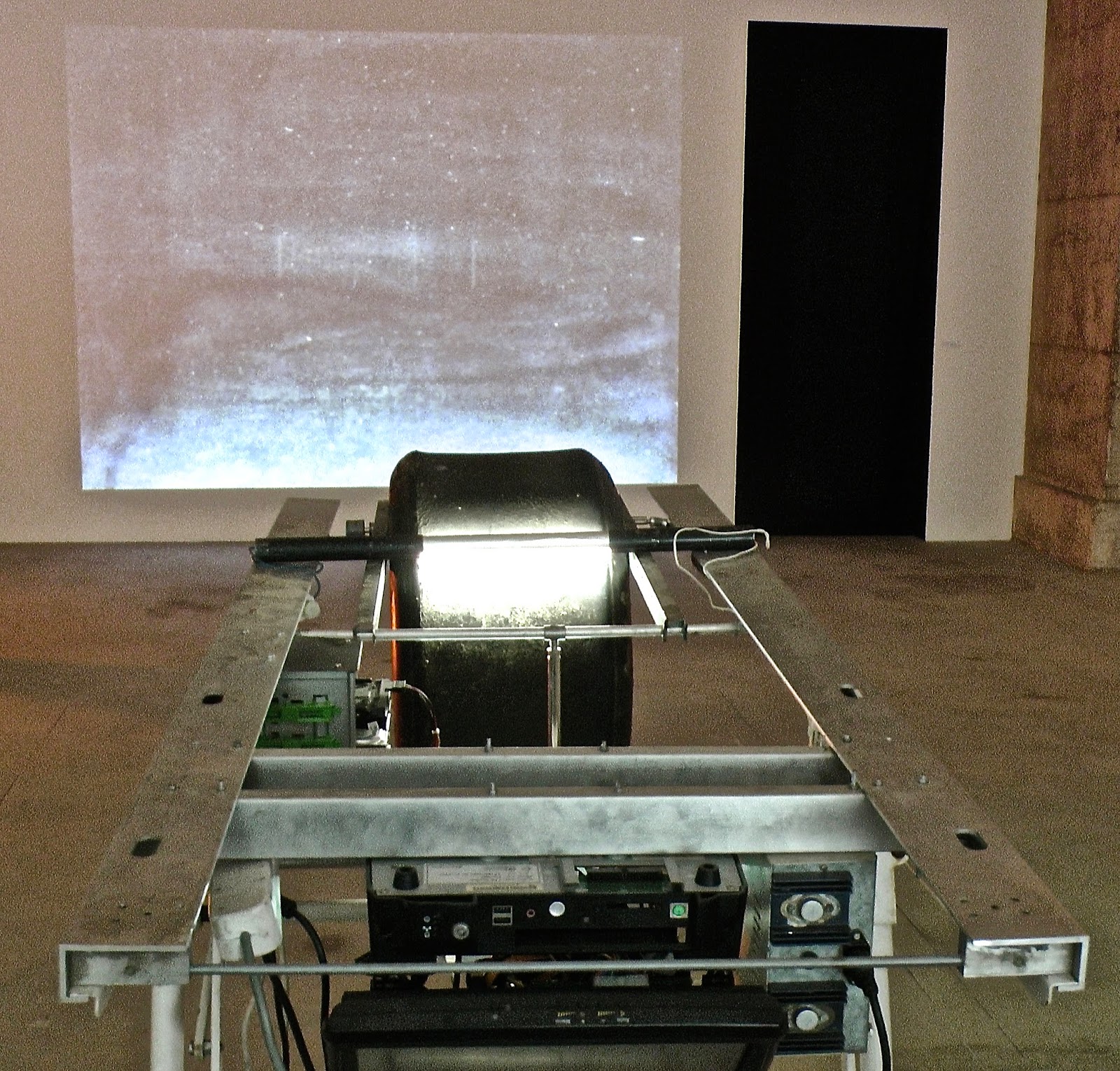
My first impression is how similar this is to say Falmouth BA show, how international is the current contemporary art. There is  video, some so dull you could scream, references to Catalan, Ukeles, odd things on poles, totems, a thing that looks very delicate and works electrically that moves that has broken, a motorbike burnt and lit by a sodium light, the work of Quentin Everte.


The surface of a tyre is being scanned and projected.At first I took it to be a video of the inside of a van with just a crack of light, maybe about immigrants being illegally smuggled in, but it's not, that's my idea for a work.
I apologize for not having the name of the artist.


The first prize the curator tells me has gone to the sound installation, so subtle that I had not noticed it, beautifully installed with pastel lit small speakers above our heads, and now I hear some bells coming from it. Simon Nicolas made it.


There's video of cleaning up after fireworks like we saw at the port a few days before but with it jerky hand held shots of children on a beach, I thought maybe also clearing, but they aren't, and five minutes to watch time code projected, which seems interminable sitting in the dark. Its by Celine Fantino.

The video of a woman  cleaning a floor and then brushing her hair with the dirty brush I am informed is a reference to a famous picture by Caillebotte of workers cleaning a parquet floor.
There is also video of a desert and a pool table with messily painted areas and paint on the balls.
There are pieces of shaped stone in an old display cabinet.
There are rather beautiful photograms of snail trails on black by Sergio Valenzuela Escobedo.

The main difference from the Falmouth show is that this one, in two venues, the larger of which I did not get to, is open for several months so it gets a reasonable audience. Falmouth is only open a week, similarly the MA show, when it's highly likely there will be no refreshments and very little publicity for the artists who have worked very hard in most cases and yet it isn't even shown so that the new students could see it, let alone showcased to any art dealers who might provide future opportunities. Is this because the new cohort will be much the same, no point in letting them see the last lot? There is also a free informative illustrated leaflet  whereas at Falmouth you have to buy a catalogue. Also there is a curator present who is happy to speak to me.

Earlier in the week we had been to the gallery in Nice which shows nineteenth century works. This again was a Europe wide style, of heavy dark interiors, narratives of slave girls and gods, history paintings, admirable in their care and observation, skill and industry, and how different from our age of peculiarly odd stuff. 

What does it mean that the lightness and love of life of the impressionists is lost to us, and what will be next? 

Was there ever thus a mass of similar art and a few things get through, through to be kept and valued, known in the canon, and from even earlier just a few things remain, not valued as masterpieces but merely for their survival, any prehistoric image is remarkable, we don't say one is good or bad.

The contemporary scene is hard work, varied, scrappy, the art seems thrown together in an afternoon, without skill, without coherence, we feel tired, unwilling to read pretentious blurb, ready for lunch.

I find I want some joie de vivre, I've just returned from the intoxications  of Matisse , Bonnard and Picasso, let's find some joy in living now despite the horrors!
It's this that I always find in dance, in jazz, in holidays in hot countries, in flaneuring,  and it insists on getting into my art alongside the douleurs.
I buy one of Sheila Stayne's sculptures, back home  in St.Ives, its to be worn round my neck, made in felt, it's deep blue with orange and pink, a 3D Trevor Bell inspired creation.


Thursday, 7 August 2014

Cuckoo Town Guide to ART

'The Cuckoo Town Guide To Art' at the theatre upstairs, St.Ives Arts Club 8pm,
July 29,August 5,12,19,26th- all the Tuesdays. 2014
Tickets £6 from Cafe Art  or at the door from 7.30

Shanty Baba and Dhyano have put this intoxicating  cocktail of surprises together and perform with panache and subtlety.

My favourite joke was an explanation of how to sculpt a dog in stone, but it's the way Dhyano tells it of course. His catwalk fashion show is also amazingly hilarious and accurately observed.
Shanty is more low key and his poetic piece towards the end of the show moves into a reflective and gentler mode to complete an excellent evening of entertaining pieces about art and art in St.Ives.  Dyhano accompanies him with atmospheric improvisation on the lovely piano in  which the Arts Club now rejoices.
I  started out thinking the artist called Sean was fiction, particularly as his names is S.Landers, but on checking online I find it's all true. He features in the section on ego.
Terry, Barbara, and many others come into the show, the latter alarmingly giving birth on stage.
There is local reference to our ex-mayor's shop and a competition to make a work of art to be judged by the audience. 
I loved the installation proposed for the Tate, presumably when Nick Serota is next on the Dali Lobster phone he will finalise the arrangements.
Don't miss it. 
You can take a bottle in and sit around cabaret style tables to enjoy a very unusual evening of original humour from these two performers who make a good team.
 I would say its unforgettable, but there is so much packed in that you may need to go twice to take it all in.

Sunday, 20 July 2014

St.Ives Literature Festival


Norway Square Blues.
[St. Ives Literary Festival 2014]

Why don’t the poets turn up on time?
We’ve heard a few by the time others arrive
- the late poets.
We’re in a time warp, 
guitars and sunshine,
a very quiet harmonica.
Cliches pile up
especially about women - oh dear
oh no - don’t
I’m cringing apprehensively now.
At least there’s a few here, thanks to the late poets
I can leave less obviously, shuddering,

but, maybe the cliches are a joke,
I’ve got it now
railroads and hound dogs
ok
he’s got it before me, not just bourbon but tea
and everything as he says 
is the blues
or will be.