Monday, 8 April 2013

'Limbo"


‘Limbo’ at The Coffin Store, Walsingham Place,
Truro - March 28 to April 14th 2013

Subtitled “The first Biannual, forming a blueprint for a future biennale’

I suggest its not just conceived, instigated and supported by Joseph Clarke, Samuel Bassett, Jesse Leroy Smith and Neil Scott but also chosen by them?

Its not that easy to find the place, there’s rather a small notice behind a few arty looking people hanging about in front of it.

The first exhibit is a sculpture by Tim Shaw of a figure on fire, which someone we knew had told us about, saying it was based on a soldier on fire in Iraq, but I don’t know if I would have realised that unless I’d been told.
Its not really got enough space  and I am most moved by the title - ‘What God of Love Inspires Such Hate in the Hearts of Men’.
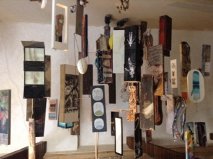

It turns out there is quite a lot to see in the show. Unfortunately its freezing cold, but after a while, finding things that interest me and getting into conversation I forget about that for a while, but its tough for those invigilating or working there.

My attention was caught by Alban Roinard’s video in black and white with words spoken in Cornish and subtitled. Its all about death and the sea and a child and remembering and its saying something that I linger to take it in again and try to learn how to pronounce a few of the Cornish words from my husband , Pedyr Prior, who can speak them. The sound is a bit low despite Jesse Leroy Smith noticing and coming over to turn it up with the remote.

A large area upstairs is given over to various artists painting from photos of famous people, but at first I don’t get what its about at all.
 Having spoken to Richard Ballinger we get into a lively conversation about suicide and include personal experiences, my online ‘Umanets petition’ protesting about the sentence of the Rothko scribbler, how and why Rothko killed himself, and how the TAap group put in a proposal for this item to be in the show. It fits well with being in a coffin store.
Its the conversation that is engaging and gets me to linger and look at the paintings and think about the subject and the fact that the paintings are being created on the spot.


There was a lot more. 
Unfortunately two electrically powered projections were not working.
 I presume one of these would have been the slide show documenting some of the many artists in ‘the south west’ which is an odd phrase to use if the future biennale is to be Cornish. 
There was neon, hanging things, paintings, sound [too loud for me] and  other video. There were socialist slogans on the rafters, which I was delighted to see. I don’t suppose the coffin makers did them?

This show made an impact and was quite a surprise just off Truro’s shopping area. 
Will it lead to a ‘Cornish Biennale’? Sounds exciting.
If so will I and many other artists in Cornwall hear about it in time to get involved? - I say this as I didn’t hear about this one until it was about to open.

Will there be a less male list of exhibitors?

Will there be more signage to get a few passers by to find it?


Anyway, well worth the trip and an inspiring spurt of energy in the art community.


Monday, 25 March 2013


13 people have spent all day arranging and installing our exhibition, over 80 hours of unpaid work, most unlikely to be repaid with any profit when the rent of the space and the other costs and invigilation time and travel are added up. Why do we do this? It's such hard work. I announced I would rather be a writer, just a laptop or a notebook to carry, no tools and lifting and co-operating. By the end of the day I am exhausted.
Beverley le Levier

Maybe on past data 2000 people will come and look over the two weeks of the show, most won't even buy a card or make a comment.
Christine Spencer-Green

The artists enjoy seeing their work on display.
We like to see people looking at it, getting something from it, occasionally someone even tells us they love it or understand it or are amused or moved or they even buy it, showing it’s valued. Someone thinks we are a good artist, they will remember our name.


Amanda Rae Thompson

Sometimes I think the pictures are just an excuse for signing our names: Kilroy was an avant garde artist, signing the world.

Helen Savage


We're not in the league where large amounts of money are made as investment. It's not the high stakes art market parallel to property speculation.
Jo Davies

It's more that we do what we damn well want to express ourselves, we own the means of production and we might make a few quid.

Janie McDonald
We'd like to be famous, well I would, so that our work would be more seen, known, remembered, make a mark on the culture, join the canon of art. We're as good as the more successful famous ones, we just haven't had the lucky breaks, we didn't know the right people, we failed to marry an art dealer, or the cognoscenti aren't ready for us yet.


Lorna Johnson
Actually when I admire some of my fellow members of Taking Space's art works they are as well done as anyone's, as original, as lively and sincere. Not all of it, I don't even like it all, but I defend its right to be shown.

It's a bit Groucho Marx, by being in this group we trumpet the fact that we are prepared to belong in a group that gives us no kudos but anti-kudos.

Joan Ford
But at least we are in a group, we do exhibit, we help one another in a democratic collective of women, we defy all those opportunities to be rejected by selectors we do not respect because all they do is choose what they like and their opinions are no better than ours.

We remember Van Gogh, to whom even a brother in the art racket couldn't ensure success in his life time. 

Mary Fletcher
Like that comic who said, 'When I said I was going to be a comedian they laughed' (it was Bob Monkhouse], 'They're not laughing now'.

We indulge our addiction to self expression, to drawing, to playing about with art materials, we imagine our willingness to carry on despite almost complete failure validates our vocation, we stand for something that defies the capitalist requirement for marketing and profit, even though we don’t object to earning enough to pay tax.

Come in, have a look, we can't stop, it grows like toenails, as I believe Picasso said, and we cut it adrift to put it into the world, more clutter, or just a re-arrangement of stuff, creation.

Twenty years of Taking Space and still going on!


Mary Fletcher.

Friday, 21 December 2012

'In The Dark Times' cmr Redruth Dec 2012


In the Dark Times - cmr - Redruth. December 2012
Members of cmr were invited to send in ideas for this show and then to attend a meeting at which those present spoke about their proposals, some of which were as yet very unformed. Following this the curators, Liam Jolly and Duncan Hopkins decided what to show and how and did the work of installing it.
On returning to invigilate I noticed that the rota had not been filled so the show had not been open as advertised, and another time I would suggest participants should be required to commit to this before their art work is accepted.
The temperature in the building was very chilly even after the two inadequate heaters had been on for several hours.
These practical matters are very important for the professional production of shows that people will bother to come to see and be happy to spend some time looking at. Interestingly there was no provisions for buying work,such as receipts etc. although some works were priced on the list provided.
As the work was installed with nowhere separated off for the invigilators to sit, we became part of the installation, two people in camp chairs, holding onto our warming cups of tea, sitting close to the heater, like two bivouacing squatters in the semi darkness, waiting for someone to come in.


At the entrance there was a shiny paper grotto to walk through which reminded some of one there used to be in a department store in Redruth. However this one contained a framed print that said 'Bomb the world', by Stuart J.Blackmore.


This encapsulated the contrasts of the show.


Jonathan Hayter's light show was a delightful visual ballet of shapes and colours, like being able to walk into a Bryan Wynter 'Imoos'.
In another room a dramatically lit mud-covered book lay on top of bundles of twigs. I didn't know what it meant. More mud books by Francesca Owen hung from a ceiling and Peter Ward showed bundles of sticks recalling a set for babes in the wood or red riding hood.

There was more about fairy tales and masks, dressing up - picked up in my ceramic figures of a New Year Bear talking to a Fairy. 
Alice Mahoney showed a rather creepy torn part of a toy bear and kit for a bear tamer.

 Ilke Cinarel’s video combining a naked man sitting on a toilet with images of children and their voices seemed similarly to hint at something unwholesome whilst recalling 60's graphics, Hockney, ‘found film’ on The Old Grey Whistle Test on t.v.?


Sara Bowler had been running mask making sessions in preparation for the closing 'Saturnalia' 


and I had invited the public to send in baubles expressing how they felt about Christmas, which resulted in a small but unusual and varied display and raised the issue of how we react to being in the grip of our culture and gained useful publicity in the local papers for the whole show. I was able to put inside a bauble shape my poem about being a humanist “It’s our Christmas Too”.

I also showed a previous collaborative piece in which people contributed Xmas tree pictures and words about their use of this custom. These had been made into bauble-like cubes to examine and re-arrange.

Duncan Hopkins had a painting in which a dark figure was behind colourful streamers. Towards the end of the show, following some unexplained bother, this was replaced by Charmaine Honeychurch's thickly painted “Calm after the storm”, the title of which may have referred to this event obliquely, which used gloriously gestural thick paint in a wintry palette. 

Ron Ford also had a whole wall of wintry and autumnal landscape modules showing his studies of the Gorran Gorras area, painted very dry and sparse and glowing attractively in the dim light.

Jayne Anita Smith had also used a mask and a strange masked figure in her paintings and sculpture, the latter shown under one of those domed glass covers that clocks sometimes have. Her paintings were small and benefitted from being shown with plenty of space around them.


“In the Dark Times” was a show swiftly put together and showed the way in which this artists’ group can be fairly spontaneous and show a variety of work that has not had to go through the many hoops that often intervene when artists make applications. Some of the work may be a beginning rather than the resolved result of long study, but it’s still interesting to see it. The curators had produced a well exhibited show, giving care and respect to each art work.
CMR is building a reputation for having something current and unusual to offer, worth being aware of in the sense that whilst at Falmouth on the MA course I heard people say that Redruth was the new St.Ives.

Monday, 17 December 2012

Rothko Scribbler does not deserve 2 years in prison-petition

http://www.change.org/en-GB/users/32831697


Dear Theresa May, [I await her reply]

Vladimir Umanets has been jailed for 2 years for scribbling on a Rothko.
This is crazy. 


I ask for his sentence to be reduced. Someone who knows how to start a petition should start one.

 People should only be imprisoned for violent crime. I am an artist and I appreciate Rothko but to take 2 years of a man's life is utterly ridiculous. 

A fine and community service would have sufficed.

Yours faithfully, M.Fletcher

The Guardian published my letter about this on Sat 15th December 2012.
By then I had managed to start an online petition, the link to which is at the start of this post.

There have been some signatures but I would like to see more people join this protest against jailing a man for defacing property.

Its depressing that so few will commit themselves to the slightest involvement in any campaigns-you'd think we were living in some fascist state and in danger of being killed if we even speak our minds-for example so few who read 'art cornwall' forum ever express an opinion-is this because they fear ridicule or because they have no opinion?
As Bettelheim pointed out, in far more terrible circumstances than I hope to endure, if one delays protest then protest becomes more difficult.


Monday, 12 November 2012

Excruciating Noise


Doesn’t anyone else mind the excessive mind-numbing sound levels that some dance companies are playing their music at?

I left ‘Some like it hip-hop’ at the interval because the noise level was too loud for me.

This week, ever hopeful, I went to see ‘Freedom’ by the Vardimon company.
The noise level this time was well over my pain threshold and I had to rush out and ask for my money back after sitting with my hands jammed into my ears for a few minutes. 

Disturbingly, I could not exit through two doors labelled ‘fire door’ because they were locked shut.

It looks as if I’ll have to stop going to Hall for Cornwall. My husband also found the noise level far too loud and was glad to leave.
Is everyone else so deaf it doesn’t bother them or too afraid to complain?
Anyway, two wasted drives from St.Ives, car parking, programmes and expensive tickets - I will restrain myself from booking for anything else and hope the Moscow ballet and Rambert dance are as wonderful as usual as I have those tickets already.

Oh yes, and Vardimon had no interval, making the assault on your ears more of an ordeal and depriving Hall for Cornwall of useful refreshment revenue and all the small audience of being able to meet and chat with fellow cognoscenti of the dance circuit.

Hall for Cornwall should issue noise level warnings, ask companies to not be painfully loud, and keep fire exits unlocked.

Sometimes ‘Freedom’ is leaving.

Mary Fletcher.


Tuesday, 8 May 2012

Words and Pictures - do they go together?


“Text’ was an exhibition at St.Ives Arts Club to accompany the May Literature Festival organised by Bob Devereux 2012.
  

The works used words in a variety of ways - Bill Bolger made a poster denouncing abstraction as pretentious but using either a copy of Kandinsky or something very similar that rather undermined his point because it was such a lively, enjoyable example.

 Brave though in St.Ives where just up the road, at The New Millenium, Trevor Bell’s large sumptuous abstracts, sometimes on shaped canvasses, offered an experience of being immersed in colours and shapes for those who can swim in such waters. However he accompanied the show with a video in which he paradoxically announced that words have nothing to do with art.


 Back in the Arts Club there were many words, mostly quietly used, needing time to muse over, a lot of grey subtlety.                                    


Russell Hedges used the gestural qualities of hand written illegibility


while Sally Macabe preferred the attractive visual look of typeface.


 Karen Foss used lines about spring plus colours and shapes dancing all over the space


and Bob Devereux achieved a balance of the text and the shapes and colours complementing one another.


 I  had a painting of the St.Paul’s anti-capitalist protest incorporating a political banner and a notice of the dates of the protest camp, so documenting it.


 I also documented, with a spiral form and thoughts written quite small within it, how I had felt about childlessness as a part of my life. I tried to attract with the form and colour and then embed a meaningful reflection in words, rather as Grayson Perry attracts one to the ceramic form and then up close you encounter something else about his life.


  Pauline Devereux had embroidered words about violence on a scarf next to a statement about her enquiry into suicides. 


 Continuing sad themes, Roy Ray had two black framed montages about young men killed in war, very stylishly beautiful but also clearly communicated and eloquent. 


 Zara Devereux used language made more mysterious by being in French and combined with subtle tones and gentle allusions which were hard to understand.


 John Higgins was clearer, with an atmospheric image of storm and lighthouse and words introduced to add something about a steamship on the Nile.


Nicola Higgins was more cheerful with a collage of delicately painted details referring  lightheartedly to experiences of Italy.


 Lastly, John Clark was commenting about culture old and new, about our sense of reality, about love, providing rather a lot to read and photographic images in negative.
Do words always dominate if they are used, whatever the relative scale or degree of fuzzy focus?
Can image and text balance and add to one another? Aren’t some words  always needed in the label, in being told about the context, or meeting the artist in person or in a book?
Do dealers sell the image of the artist, often in words, as much as the artwork?
Some artists want to be vague, to suggest, to leave a lot to the viewer to imagine or complete - perhaps they are vague themselves and don’t want to commit to anything?
 I want to be as clear as I can, to communicate my ideas as simply as I can.