Monday, 3 August 2026

Ken Turner solo show Penzance 2026

 Ken Turner is 100 years old, still painting, and celebrating his birthday with a solo show at Penzance’s Wharfside Gallery, 10-7 Tuesday to Sunday, 23 July to 4 August 2026.

If you google there are very few artists alive and working at this age and that in itself made me approach the show with awe akin to seeing Keith Richard perform, and he and Mick Jagger are a mere 82 years old.

It’s a large room full of big square paintings in a vigorous expressionist style that convey emotion - anguish, rage or excitement.


‘My Ride Over a Tesla Car’, 2025, is one of the most memorable as it’s linked to Ken Turner’s performance, actually driving in a Sherman tank over a Tesla car with FASCISM as its number plate,  as a protest against Musk and all he stands for. What a wild and genius idea.

You can watch this and many of Ken Turner’s  previous performances on video there and headphones are provided. 

There are also available to buy two books Ken has written.
The breadth, inventiveness, humour, outrage and variety are inspirational. Also the sheer sangfroid to keep going, keep caring about the state of the world, and the craziness of the art world, despite the seeming indifference of people who are  passive as Ken tries again and again to provoke them.


‘Grief of the World’ is a quietly grim picture of endurance with a face rather like Ken’s own.


‘Nature is Crying Out’ is a wonderfully complex composition carried out with such panache and vivid sense of design that it holds your attention.

Well here’s a happy birthday to Ken Turner.

An exhibition I leave feeling encouraged to continue.


‘

Saturday, 20 June 2026

Women Artists at Penlee House, Penzance

 ‘Making her mark: a celebration of women in art’  29 April until Sept 27 and touring to Worcester and  Fife, a joint curation, with Katy Herbert in charge in  Penzance at Penlee House and showing over 60 works from the last 150 years.


The show’s title could have made more clear that it features women artists, not images of women.
It’s an exhibition of astonishing juxtapositions. Most remarkable is the inclusion of a Tracey Emin, a  bold, naked figure, autobiographical, drawn with great panache.


For habitues of Penlee house there are old favourites from the Newlyn school, refreshed by being alongside other artists that visitors may find new to them.
There has been some community involvement, shown in collage form and a slide show. There is even a rack of relevant children's books to look at.
Also you can make your own contribution by drawing spontaneously onto a computer screen.
It’s a great collection of work from two centuries and the show is educative via captions about the way women have progressed in being accepted in the art world.
I imagine every region could produce similar interesting comparisons and progress, but it’s Penzance that has cooperated with Worcester and Fife to bring us this and I wish there was a catalogue to purchase to encapsulate this story and record its success for posterity. 


Monday, 1 June 2026

BA FIne Art and Drawing at Falmouth 2026

 Falmouth BA show is a fantastic opportunity to see what students have been doing on a huge variety of of courses and I wish it was more advertised.

I saw the BA Fine  Art and BA Drawing shows and that’s such a lot to take in I was exhausted although revived by an interesting lunch, having had to email to make sure the cafe would be open.

There were very young people about along with their parents for interviews and information which reminded me usefully that most of these graduates are also very young. Having done a variety of work over 3 years they present only one project

 Some staff member must have decreed that Fine Art students would not make their identity clear by having their names and statements next to their stuff. Instead you had to find leaflets just outside the rooms which you were asked to put back if you read them. This makes it less likely that names will be remembered  or anything sold - no prices either. Are any art dealers even invited? Business cards disallowed this year?

Is any advice given about how to progress in the ridiculous art world, how to organise an exhibition etc? Or do the tutors as in my day not touch on these subjects?
Hopefully the male staff no longer prey on the students sexually and hopefully they encourage rather than standing in a group around one student tearing into them with criticism until some burst into tears.

In Drawing they had the gumption or funds to make an informative free catalogue with even the names of the staff who run the courses. Here one artist was actually  present - most of the show has not even student invigilators. 


  Matthew  Amos had observed houses where he came from and done small detailed paintings of suburbia, including a butcher featuring a menacingly large English flag. It made a point.
 Students show little interest in Falmouth-   perhaps earlier course work required them to look around where they live?
There is hardly any painting although the shop still sells the materials.

Instead there are a lot of installations. These range from a fridge containing a few melting ice molds of foodstuffs to a detailed construction of a snooker club with a feminist message.
Another  would be feminist thought, wrongly in my view, that she could further this by constructing a sleazy night club booth with neon and a revolving female leg.

There is hardly any obvious politics beyond interest in nature’s importance, one  controversially using young trees taken from their habitat.

One piece, by Farah Bhatti, I found eloquent was a presumably Palestinian floor design with irises made to emerge growing through  its smashed surface - life despite destruction.


There are quite a lot of students taking the opportunity for self reflective  examination and here the most powerful was a room with obligatory warning of upsetting content, Inside a slide show clattered relentlessly in the centre showing the clinical notes about the artist , Francesca Pease, who was sectioned and treated for anorexia. Around the outside were expressive drawings showing patients holding hands between  their beds or a circle of naked people.
It was the contrast  between the lively inner life and the matter of fact records kept that was brilliantly poignant.


 Another piece I liked , by Amy Higginbottom, was the only one depending on active audience participation and was unfortunately closed when passed - but  it was a Photo Booth using old fashioned developing of film - you could see this done through a window in the shed - and photos from it were exhibited along with a box of slides - oh the nostalgia of past hands on  tech!


And the nostalgia for those happy days seriously playing around with art before working to live usually intervenes - but still a creative basis for life - unhappily now open to fewer from less wealthy families who don’t want to incur huge debt.

Best wishes to them all - as they leave the paradisiacal Wood Lane campus with its palm trees by the sea.


Thursday, 14 May 2026

Aleksandra Kasuba at Tate St Ives until October 2026

 Aleksandra  Kasuba is the artist shown at Tate St Ives 2 May  - 4 October.

The show is called ‘Shelters for the senses’ and introduced me to this Lithuanian/American artist, born 1923 and died 2019, four days after her gift of her seventy years creative work arrived to be displayed in the Lithuanian National Museum of Art.

Tate provide a timeline at the start of the exhibition with details of Aleksandra Kasuba’s life. 
She was a princess but the Soviet occupation nationalised the family estate, she then became a refugee from Nazi invasion and from a Munich refugee camp in 1947 went to USA, and ended her life in New Mexico.


                                    Four Seasons 1957


We see a couple of early examples of Kasuba’s art before the star of the show, the glowing rainbow curved structures which you can walk through. If you arrive at 2.30 you can choose two scents on sticks to enhance the experience.


There follows pictures of this artist’s curved dwelling in New Mexico, which was made as a place artists could stay in for contemplation in the desert surroundings, but from my research is not available for residency  applications.


There is also a soft carpeted structure designed for rest, which you cannot enter, and photographs of a textured outside wall at the New York Twin Towers, which along with the Towers was destroyed by the infamous attack.


I found it a refreshing show, giving me knowledge of an artist new to me, one with many interests, in materials and structures, whose art was all about restorative enjoyment. 

The exhibition raised questions about how artists become known internationally, how Tate obtains their shows, and how very many interesting artists there may be as yet uncelebrated and unknown.

 Aleksandra Kasuba as a  Lithuanian refugee was made welcome in USA


Sunday, 19 April 2026

Two books about Ben Nicholson

 There is a Ben Nicholson on show at the moment in Tate St Ives.

This is what prompted me to read more about him and I found two very different books in the library.

Sarah Jane Checkland wrote ‘Ben Nicholson - the Vicious Circles of his Life and Art’ published 2000.
The title tells her approach and in fact the only photographs included are of people not of the artist’s art.
The author has done extensive research and tells us as much as she can cram in a gossipy journalistic amusing way. 
Ben had a sad childhood and was sent to boarding school.He did not do well at art school.
He was asthmatic so unfit for service in WW1. He married three times and had various lovers, creating triangular relationships that caused Winifred and Barbara a lot of pain, but as the author points out he avoided triangles in his abstract works.
He and Barbara Hepworth formed the Penwith  Society in St Ives which broke away from the St Ives Society in order to promote abstract art.
There are many interesting details about Ben’s life and how abstraction became more popular after WW2, aided by Munnings’ reactionary speech 1949 at the Royal Academy denouncing it as rubbish,  which was  broadcast on the radio. 
By 1950 Nicholson’s work was a global success. He married his third wife, Felicitas Vogler and lived in Switzerland before returning to England.
He was involved  in Christian Science, had some Adlerian psychotherapy sessions, and gave credence to psychic beliefs and astrology.
Overall we get a complex picture of a man who was not very likeable although several women loved him intensely.

In contrast Virginia Button’s ‘Ben Nicholson’2007, in the Tate’s series on British artists, has many coloured photographs of Ben’s work and a narrative stripped back like one of his carefully crafted surfaces. 
Button is far more interested in art than is Checkland, whilst referring to the latter’s book, and gives us more to think about in analysing how Nicholson’s work developed and issues such as truth to materials, political and spiritual connections and how his work fits into art history. Ben responded to Japanese aesthetics and the author finds in his pictures ,which combine references to visually observed landscape and still life combined with abstract form and composition , ’poignant visual poetry. ‘

For clarity and artistic perspective on Ben Nicholson’s work read Virginia Button: for gossip and a critical account of his life it’s Checkland.
In this case the covers sum up the difference.


I saw a retrospective exhibition of Ben Nicholson some years back which showed how clearly he was affected by the work of others, changing his own in response. I thought the period when he was first in love with Barbara Hepworth was the most interesting when his personal life motivated figurative imagery expressed within abstract language - the time from which comes he picture I saw in Tate St Ives.


Friday, 17 April 2026

Huw Marshall , a Scottish artist in Penzance.

 Huw Marshall, an artist from Scotland who lives in Penzance

Huw had a week’s exhibition at Redwing Gallery in Penzance in May 2026 and he agreed to be interviewed by me soon after this in his studio there.


I have seen some of his large paintings - very striking, expressionist, full of movement and contrasts of colour and tone, showing figures dancing or moving.


The problem is because I know some details of his life I am expecting certain things and I can’t now tell what would be conveyed if I did not know what I do. 

Does the artist want us to react without knowing - I think so - I think he hesitates to be explicit and uses his art as a therapeutic help - as he says to keep himself sane - in the face of sorrow and protecting his audience from feelings to which he alludes in poetic oblique ways.

Huw told me he has a subject in mind for a new work,  ‘ the distance between two people when one of them is dead’ - a subject I know something about from my own life.

Huw Marshall is from Scotland but has lived in Penzance for years, devoting his time to painting since he retired from being a GP.
His life as a doctor was devoted to helping people and people are his subject.
He knows enough of anatomy to be able to draw figures from his imagination convincingly and he used to go to life classes.

Huw is not concerned with his art career, not expecting or pursuing wide sales or fame or thinking that these would help him, but having a studio at Redwing Gallery provides a safe although austere space for him and he can mix with people there and drink excellent coffee. It’s a community interest company run to help art and music, green issues and veganism flourish and has become the hub where many interesting groups and individuals meet. 

Artists Huw admires include Breughel, Bosch, Rubens, Rembrandt, Van Gogh, artists of  the First World War  and the living Glaswegian artist of the war in Bosnia- Peter Howson.

On the wall is a large 12 x 5 foot composition in grey tones based loosely on the Last Supper but with many figures which he refers to with humour as ‘Last orders at the Bowling Club Social’. This has poured out spontaneously in a few days, carried out with 6 inch brushes. It’s not finished yet.

In his recent show there was a similar sized one of three angels, using a limited palette, showing them as strong, interlocking, vivid but calming.
Asked if he believes in angels Huw says he does, as a something that looks after him, whilst he also has a scientific non religious outlook.


He is an artist of paradoxical contrasts who works from the heart and makes a rather wild and strange impression, original and worth seeking out.

His beloved female partner was murdered a few years ago and the tragic intensity of that I think vibrates within Huw’s work.


Thursday, 2 April 2026

Newlyn Society of Artists at Tremenheere until April 19th. 2026

 The Newlyn Art Society has its April show at Tremenheere- selected by film critic Mark Kermode, ‘Eye of the Lens’. No theme was set. Open daily 10.30 t0 4.30 with free admission until April 19th


I arrived frazzled by tense driving on narrow roads but on leaving after an hour examining the probably 100 exhibits by almost as many artists I somehow felt more equal to the road challenges and coped with getting lost with equanimity so maybe the art had left me somehow slightly braver.


It’s quite hard work taking in such variety although the artists’ statements can help where works baffle. I would have liked cvs or brief biographies also and a photo of the artist.


One of the people who use video gets a whole room for their evocative installation using toys and objects from their childhood - Mike Thorpe. Two vases, one with tulips standing up and the other with them collapsed as they decay seemed a metaphor for our brief lives à la Rubaiyat of Omar Khayyam- ‘the flower that blooms today tomorrow dies’  - preceded in the poem by ‘one thing is certain and the rest is lies’. The artist’s mother had died when they made this. The sounds of a child’s xylophone add to the solemn sadness and permeate the rest of the show.


Janet McKeown gets her own video screen to show badgers and rabbits on a night recording video with a soundtrack on headphones of busy human chatter contrasting with nature’s quiet woodland activity.


The other, silent, video contributions are unfortunately put together on a loop, at least with the times given and with seating but it seems likely most visitors won’t last  out to see them especially as some move at a glacial pace.. The drawn animation by Karen Lorens stands out as it’s fast paced and amusing.


A photo of Ken Turner by Patrick Shanahan also impresses in its precise recording of the artist, now a phenomenon himself as he is aged 99, and Ken has a powerful anguished painting of sorrow upstairs ‘weeping world’.


What an odd building the gallery is with no internal staircase so you have to walk up the slope and round to see the upper floor.

I found Phil Booth’s 3d work ‘Lion Hunt - Golden Horse’ baffling but so well made.


The small figures contrasting Stone Age with Tin Can age confronting one another were clearer - but then the title corrects my interpretation as it’s called ‘Bal Maidens and the Tinnie Boys’ by Julia Giles.


I liked the way Sally Tripptree had assembled small painted elements into a whole by stitching.


‘New year morning ‘by Stuart Ross was wonderfully clear but impossible to photograph without my reflection in the glass. It shows the moon in a clear blue sky.

Many of the NSA artists I am not aware of exhibiting anywhere else, which is where cvs could help, but it makes me think how studded Cornwall and possibly most of the world is with artists, addicted to making art which rarely sells but piles up, often unseen even. 

Later that evening there was art on tv from cave walls in France made 33,000 years ago. No one really knows why those artists made theirs. Their drawings were just as good, as vivid and somehow necessary as what we do now.


Saturday, 14 March 2026

Knausgaard 'School of Night'

 The School of Night by Karl Ove Knausgaard.  2025


I really like Knausgaard’s writing - the simple way it flows, the inclusion of all sorts of cultural references, the surprises in the plots, the introspection and the convincing detail. Not the lack of chapters.

This one is all about a narcissistic man, who deceives himself and  behaves badly.
It’s hard to believe that in the undescribed gap of 20 years he has found a woman who agreed to marry him and have a child.
I believed that he feels close to his little boy and also that he simultaneously and dangerously wants some distance from him.
He lacks insight and foresight but has somehow found great success in life.

As the protagonist, Kristian, is a photography student there is a lot included about this medium and his progress with it.
Along the way  there are many references to Christopher Marlowe and to Faust and a sense of karma.
He meets a strange character called Hans who I expected to lure him into something evil but it’s more complicated  and inexplicable than that.

We do not find out why Kristian is the way he is, alienated from his family, unempathic  towards  the women he meets, old fashioned in his stereotyped views.
It’s unusual for an author  to try to inhabit such an unpleasant character but despite disliking  Kristian I still wanted to read on and find out what fate had in store for him.
It’s shocking to be alongside him, realising how little one knows what others are really thinking.

Like Mephistopheles the author gives and takes away and we the readers, having entrusted hours to the story, are held willynilly in its grasp until we emerge battered by fate.


Monday, 9 March 2026

Wild Thing - a life of Gauguin by Sue Prideaux

 ‘Wild Thing - a life of Paul Gauguin'  by Sue Prideaux, 2024


Another book on Gauguin, this time covering his whole life and evidently using extensive new research.
It’s also vividly written - a page turner of art history- and has a lot of illustrations.
Sue Prideaux is good at evoking the era and context in which Gauguin lived - whether the decadence of modernised Paris or the colonial impositions on Tahitian culture.

She brings her own insights, such as how Gauguin admired Manet’s ‘Olympe’ and shocked the art world in Paris with his South Seas versions of female nudes and black versions of Christian stories which the Pope had declared forbidden blasphemy.

I hadn’t realised that a stock market crash left stockbroker Gauguin needing to find and fail at other jobs, or that he long wanted to be reconciled with Mette his wife and their children and that he was faithful to her for a long time and unlike Van Gogh did not visit brothels.

It was also a long time before Gauguin became a success as a painter. However Theo Van Gogh, so strangely unable to sell Vincent’s pictures, sold one of Gauguin’s for 300 Francs 1988, which my googling tells me would be £3,000 in today’s money.

It seems his wife Mette was a prominent entertainer of avant garde friends in Denmark. Also Gauguin had a circle of cultural friends in Paris such as Strindberg, and at that time there was great interest in Norway and in symbolism.

The author emphasizes Gauguin’s support of women's rights and his lack of racism and  his practical helping of Polynesian folk against the inequities of colonial rule. He was very interested in the  culture of the islands, where French missionaries were in conflict with a very different attitude to sexual conduct. Gauguin was provided by his local neighbours with offers of their young daughters, with several of whom he formed relationships and had children. The age of consent was both in France and in her colonies only 13
It’s rather a confused picture Prideaux gives where native cannibalism and infanticide  is hinted at and for all the talk of freedom there was an expectation that young women would be sexually available to much older men they scarcely knew, whilst at the same time they were able to leave them and unmarried pregnancy and abortion were accepted.
Gauguin had a lot of health problems, some stemming from injuries during a fight in France, but was not syphylitic - three teeth found of his after he died having been extensively examined by scientists.

Prideaux writes carefully about Gauguin’s art, getting the reader to look again at long known paintings such as one of women on a bench which was in my classroom at my girls’ grammar school in the sixties but turns out to be of prostitutes.


Gauguin frequently clashed with the French authorities, wrote articles for a satirical political magazine  and was arrested at the end of his life for libelling an official. He was by now much wealthier and had had built a house he entitled ‘The house of pleasure.’ 

 Gauguin evolved from devoted family man and establishment member however rebellious  at heart to being the wild man in the tropical jungle with a string of pubescent lovers. A great story with the topical problem of predatory male figure in a society that allowed this, and with subject matter he made his own - of a sort of mythic shangrila in which he lived an all too difficult life living on tinned food and sending out his colourful visions of life in a distant place to sell in the western art market. 


Sunday, 15 February 2026

Penlee House, Penzance Jan21-April 16 'Through the Lens' and 'Face to Face'

 Penlee House   Harry Paul ‘Through the Lens.’ & ‘Face to Face: Portraits from Penlee’s Collection.’
Jan 21 -  April 16 2026

These two shows contrasting one man’s photography with portraits by many artists make me think of many questions about the two forms of art.
I started with the paintings - some of whose creators will have referred to photographs. Portraits take time and skill, often conversation takes place between artist and sitter. They may have informative backgrounds. Some are of named people whereas others have titles denying them even a name. One of the newest acquisitions, by Leonard Fuller, of a young woman, looking as fresh as if it was done yesterday rather than in 1930, is entitled ‘The Silver Jacket’.


 Another is called, ‘An old Jew’, by Opie, 1779, but thought to be of Rabbi Abraham Hart. Another is ‘Maroon and Gold’ by Ruth Simpson.
Walter Langley uses his picture of Grace Kelynack, an old lady,1883, to bring us a poetic title that makes us think, ‘Time moveth not, our being ‘tis that moves’ from a verse by Henry Kirke White.
Most controversial is Dod Proctor’s naked adolescent girl, displayed alarmingly as if for sale and labelled ‘little sister’, 1933. Presumably this was not objected to then in a different era, although even on grounds of being severely badly proportioned it might have been criticised. It’s rather an embarrassing shock within the show.


We can learn much about the social history of the times from both the paintings and the black and white photos of Harry Paul, 1914-1957. 
 Some of the equipment used is displayed. I overheard visitors exclaiming as they found  images of people they knew.
Here the spontaneity of quickly taken photos, which can catch a moment of interaction, maybe a smile, shows the new medium off well. 


Compare a stiffly posed painted  ‘’woman mending nets’ by Ralph Todd, probably 1920’s, with the 1950’s photograph of net mending -   Philip Paynter of St Ives. However Fred Millard not only paints a finely observed woman threading a needle, 1885, but combines this with the philosophical title, ‘The thread of life runs smooth as yet’. Maybe he used a camera to help him catch the detail, then probably needing to use his eye to record the colours.


So we see here that although no one asks if art is photography, photography is surely an art.


Wednesday, 17 December 2025

Emilija Skarnulyte at Tate St Ives December 6, 2025 - April 12 2026


Emilija Skarnulyte {pronounced Scorn you Lee two} is the new artist 
at Tate St Ives
 until April 12 2026.
She is from Lithuania but has been working from a Porthmeor studio in St Ives recently.


The first room of her show has a video on a large screen of her blind grandmother slowly feeling around the bases of some enormous Soviet era statues which are in a park near her home. The soundtrack is of soft sounds and the ceiling is hung with aromatic herbs from Lithuania.
I sat on the bench to watch it and found it rather beautiful and thought provoking. The poem about blind men feeling an elephant and each reporting it to be something different came to mind.
The woman’s blindness was probably caused by nuclear fallout from Chernobyl. On her radio she listens to an old fable about a fisherman and a princess.

The larger gallery has some glass objects and a two sided video made in Cornwall which features the ancient stone men- an- tol.
However, these are insignificant within the huge installation of four curved screens and the back wall, on which are showing enormous projections of all sorts of images from nature. The sound is often a low sort of overwhelming roaring and there is very little seating unless you fetch a chair from the side or bag one of a few provided upholstered loungers at one end. 


I felt concerned for the staff confined in semi darkness with this booming in their ears, but was assured by a very helpful and knowledgeable young woman that they only spend an hour at a time in there.

There are four curved screens but all show the same thing.

I found it all as domineering as the soviet statues.

It also struck me as a good idea for a discotech - reminding me of the 60’s when people were stoned and moving shapes from oil trapped inside slides were moving on the walls. 
I watched as visitors seemingly bemused gave it all a few minutes of their time.

Reeling from the immersion, I staggered out gladly into daylight and the marvellous rushing waves on Porthmeor beach just opposite the gallery.

So, the first part I understood, it felt thought out and meaningful.

The second part was an unpleasant experience and not entirely clear  - the uncontrollable forces of nature versus the insignificance of humanity?
 
 
I include the artist's statement and gallery note.


Tuesday, 4 November 2025

Rambert Dance, Hall for Cornwall Oct 31st 2025

 Rambert Dancers performed ‘Bring your own’ in collaboration with (LA)HORDE at Hall for Cornwall, Truro October 31st 2025


Drawing I made during the first part of the show-in the dark. 


Rambert have been changing. They used to present very beautiful abstract works, lots of dancers in skintight colourful costumes, often performing in unison with impressive skill. 
The skill, commitment and unison moves are still there but the mood has changed.

In the first piece, ‘Hop(e)storm.’ Women threw themselves at men, who dragged them back to be left at a distance. This was repeated for about five minutes, followed by the couples instead dancing in wildly exaggerated Lindy hop inspired ways, to mostly strange electronic noises. Some of it was humerous, all of it energetic.

This was followed by ‘Weather is sweet’ . The relevance  of the title was unclear. Dancers interacted in ways suggesting sexual contact, although later in the question session we were told the bottom pushing down to the floor  movements were inspired by basket ball. It was very inventive and rather puzzling with circus elements, a savage playground of lots of yanking of bodies, jittery, masturbatory  gestures and no feeling - like an automated fury of sex. The sound was unpleasant electronic noises but mercifully not too loud.

Lastly after the interval we saw ‘Room with a view’. Not at all a reference to EM Forster or Noel Coward. In this a varied crowd of dancers moved with increasing frenzied  unpleasantness, running in circles, gesturing rudely at the audience, shouting and ending up looking like a group of medieval flagellants.
I found it a tedious overload of exhausting menace and despair. 

The audience were very appreciative of it all. The screamers and whoopers were in. I couldn’t see anyone else refraining from applause in protest at being trapped as the focus of abusive angry outpouring. Turning the house lights on briefly emphasized the assault. Maybe the applause was just admiration for the dancers‘ stamina or identification with alienated rage?.
To be sure it was very competently done.

The Q and a session was mildly interesting but no critical questions were asked  - my waving hand was not selected. It was admitted that the response at all venues  was not always so supportive. In Cornwall we don’t get much post modern dance to see and hear so maybe anything however agonised is welcome drama.

I wished the online reviews had been more informative of the ordeal offered. 
I will consider carefully if I want to attend next year - Rambert have removed themselves from the aesthetically pleasing with a vengeance with this programme.


Sunday, 14 September 2025

Talking Posh

Talking Posh 


from bbc 'The Frost Report' 1966 sketch on class. 


 Recently I found out that two artists I came into contact with years ago were not as I thought from a different class from my own working class origins.

The first is Julian Spalding, who was on the same BA course as me at Nottingham University in the 60’s although he started  the year before.. He was an eloquent and passionate speaker who involved himself in our minor revolution on the fine art/ art history course when Hornsey students came to politicise us and we demanded to learn about art beyond Europe and America and to reinstate a student who was suspended. We succeeded in the latter but were told staff could not expand the scope of the art history as they  did not know about it themselves. The course was unusual and short lived as a collaboration between the University out on a campus and the Art School in town.
Julian went on to be the director of Glasgow Art Gallery and wrote several books, in which he shows an individual taste in art and distaste for establishment views on what is good and what is discarded from the canon of modern and post modern art.

Only recently I found out  his admission that he grew up on a council estate in London and made a conscious decision to change his accent to the classless ‘ Received Pronunciation’and thereby more classy bbc English that probably aided his success in life.

My father had the foresight to recommend this course of action to me and offered me elocution classes but I for political reasons of loyalty kept my Derby accent and took lessons in singing instead, leaving these when exhorted to use a long a and to sound operatic.

 The other man was Victor Burgin, who loitered looking pale and interesting with a wild head of dark curls in our life studio. I thought  he was a moody student but he turned out to be one of tutors, albeit avoiding interacting with us. He was a little older and already engaged in conceptual art although he never told us anything of it. I found out then that his art included taking a photo of a parquet floor and attaching it to the floor over the spot of which it was a photo.
 I don’t remember him speaking at all, only that he had a relationship with a young woman  student at the art school, something that was common for tutors to do at the time, and that she was featured in a national newspaper as an artist and also had an abortion. I don’t know if the relationship with Burgin was a factor in these two events.

Victoria Burgin went on to academic life in America and to carry on photographic work as a high status theoretical artist. You can see and hear him being learned and interesting on YouTube. Unlike Spalding, Burgin speaks in a very slow flat tone devoid of excitement. (Strangely he pronounces ‘semiotics’ and ‘Brechtian’’ in not the accepted ways.) He  is part of the post modern art world, successful although not very famous, making art with leftwing political and feminist awareness. His accent is again classless bbc, fooling me into thinking his origin very different from my. own. 
Now I find he grew up in the shadow of a steel foundry in Sheffield and had experience of manual labour. He mentions working at Nottingham but not the life class part.

Of course the  sixties was actually the era when working class people were able to get a university education with the aid of government grants because of the Labour Wilson government system of grants. Actors were suddenly able to use their regional accents.
The Beatles were clearly from Liverpool.  

 I find these two men used a clever strategy of hiding their working class origins - in the loose sense of working class to mean the bottom sector of a three rung society, not the Marxist sense of those that work for others, not owning the means of production.
I wonder if they can still talk not posh?

I must add both Julian and Victor are clearly very clever and accomplished and interesting .

I wonder how much these differences of accent still matter, how much advantage  ‘ bbc English’  gives, with its assumption of being well educated and well heeled?
 How much this sort of thing applies outside UK?


Friday, 20 June 2025

Liliane Lijn at Tate St Ives June 2025

 Liliane Lijn ‘Arise Alive’ Tate St Ives, 2025 May 23rd to November 2nd.

Liliane Lijn’s work fills the new gallery at Tate St.Ives, making a dramatic expression of her long life as an artist and she was there at the private view.
How great indeed to see a woman artist celebrated whilst still alive.


In the 60’s she began using technology to make kinetic work using acrylic and light and her  ‘Liquid Reflections’ which is viewed in a dark room is fascinating to watch as pairs of  spheres move about on circular platforms, occasionally bumping into each other or the rim with a soft sound and casting ever changing shadows and reflections.
This was made in 1968 and as a student I saw it in Nottingham. I even made my own circular platform with moving spheres afterwards. Mine was  plywood, mounted on bed springs so that it hovered if touched, and my many spheres were polystyrene coloured pink blue or a mixture of both. Mine was symbolic of people bumping into each other, a product of the excitement of being at college studying art and suddenly meeting lots of people. This makes me wonder if Lijn’s symbolises the meeting of two people.


Some ideas are in the air of an era. I find Yoko Ono exhibited one clear sphere on a plinth in 1964, with a conceptual label - ‘Pointedness 1964, first realised 1966. Crystal sphere, acrylic pedestal. Engraved: POINTEDNESS YOKO ONO 1964 / THIS SPHERE WILL BE A SHARP POINT WHEN IT GETS TO THE FAR CORNERS OF THE ROOM IN YOUR MIND”
Ono characteristically says a lot with a ‘less is more’ wit, contrasting with Lijn’s use of motors and technology.


Lijn also used prisms and I remember in 1971 being sent out to Tottenham Court Rd whilst studying to be an art teacher at London University ‘s institute of education to buy some, as many others must have done. 

Of course Tate as usual present an artist in a solo show with no context which is why I note that ideas are often widespread - but Lijn was able to seize the moment and made remarkable work with them.

Lijn comes from a wealthy family, met important people in the art world - surrealists in Paris, and she married Takis a wealthy successful Greek artist so  she was able to devote herself to art, even sending her son  away to be looked after by her separated parents in turn.
Her love life was rather turbulent until she met her current husband.

Alongside the cool quiet work there are paintings and sculptures that are linked to psychology, to archetypal figures of woman. 
Here Lijn uses colour and expressive marks to convey strong feelings. Her ‘ Good Mother, Bad Mother’  reminded me of Kokoschka in their swirling application of colour.
The two large sculptures, ‘Woman of War and Lady of the Wild Things’  that perform together on the hour using light, sound - sung by Lijn -  and spouts of steam - carry on the theme of woman as having strength, sometimes frightening, sometimes wild but welcoming.

The show is on until November and there is a lavishly illustrated book to accompany it plus Lijn’s memoir ‘Liquid Reflections’ which is an easily flowing candid account of her life.

Unfortunately Tate have discontinued the helpful booklets that used to inform and be a  memento of shows, but as photos are allowed you can make your own selection  of images and wall captions and also you may attend the talks that are given where your questions can be answered.

Lijn’s show is wonderfully varied and is likely to remain in the memory of visitors as a unique event as well as confirming her place in the canon of art history,


Arena TV program on Salgado -photographer.

 Salgado:the Spectre of Hope - Arena, bbc,  directed by Paul Carlin, 2001

This program was repeated in June 2025 because the Brazilian photographer Sebastiao


Salgado died in May aged 81.
It was preceded by an Omnibus showing his vibrant pictures of manual labour.
The Arena program shows Salgado ‘ in conversation’ with John Berger although it’s more that they speak in turn.
The photography is impressive and shows people from various locations forced by the vagaries of capitalism into becoming migrants, desperate to find security for themselves and their families. Salgado spent years researching,  meeting the people, editing to choose the most expressive and emotive photographs, and he speaks movingly in imperfect English with apparent sincerity.

What I don’t like about the program is everything that isn’t Salgado undiluted.
There’s woozy romantic sad music. There’s John Berger reading poetry and making obscure remarks. The movie camera zooms in on the images and shots are overlaid, emerging from this obscuring artiness when I want to view the still photographs calmly in their stillness as Salgado took them and printed them and selected them for his book. His aim is to make us aware of these migrations and to question the political and economic system that causes them.
He asserts that in this system only one in four people benefit.
The film maker intersperses movie shots and words from people about their plight.

There are unfortunately no statistical facts to back up this vision but it is powerfully convincing in its  repetitive relentless pictures of desperate looking refugees, beautifully captured in black and white.
Nor is there any political thought or theory about how to change capitalism. That’s left to us to undertake.

It’s great to learn about the photography of this committed man Sebastiao Salgado.
But it’s not helped by this Arena programme’s style and approach.

Gauguin -a new book about this artist and his time in Polynesia

 ‘ Gauguin and Polynesia ‘ by Nicholas Thomas, 2024

This book is written by someone who knows Polynesia and has researched his subject.
He considers the usual things said of Gauguin as a person that are very critical of his character, and looks at his paintings in detail. There are good reproductions that enable the reader to also do this.

Nicholas Thomas warns against taking the Somerset Maugham book ‘The Moon  and Sixpence’ as giving us any truth about Gauguin although he inspired it.

The questions of Gauguin’s  exploitation of young girls as sexual partners and of how far he gave a nostalgic romanticised  view of a French colony are addressed seriously.
It made me consider that my first instinctive responses to the paintings as enjoyable were worth something.
It doesn’t make Gauguin into a saint but it helps to reassesss his attitudes and it’s a fascinating read.

There is a copy in Cornwall County library, otherwise it costs £40.


Sunday, 18 May 2025

Trinity Buoy Wharf Drawing Exhibition at Falmouth Art Gallery May 2025

 I saw this in Falmouth, Cornwall, Uk in May 2025, but it has toured around the country and is an annual opportunity to submit work defined in any way as drawing.

Such variety - quite a lot of intricate pattern done for its own fascination.

There’s a catalogue to consult whilst there to find out more about each artist or you can buy one.

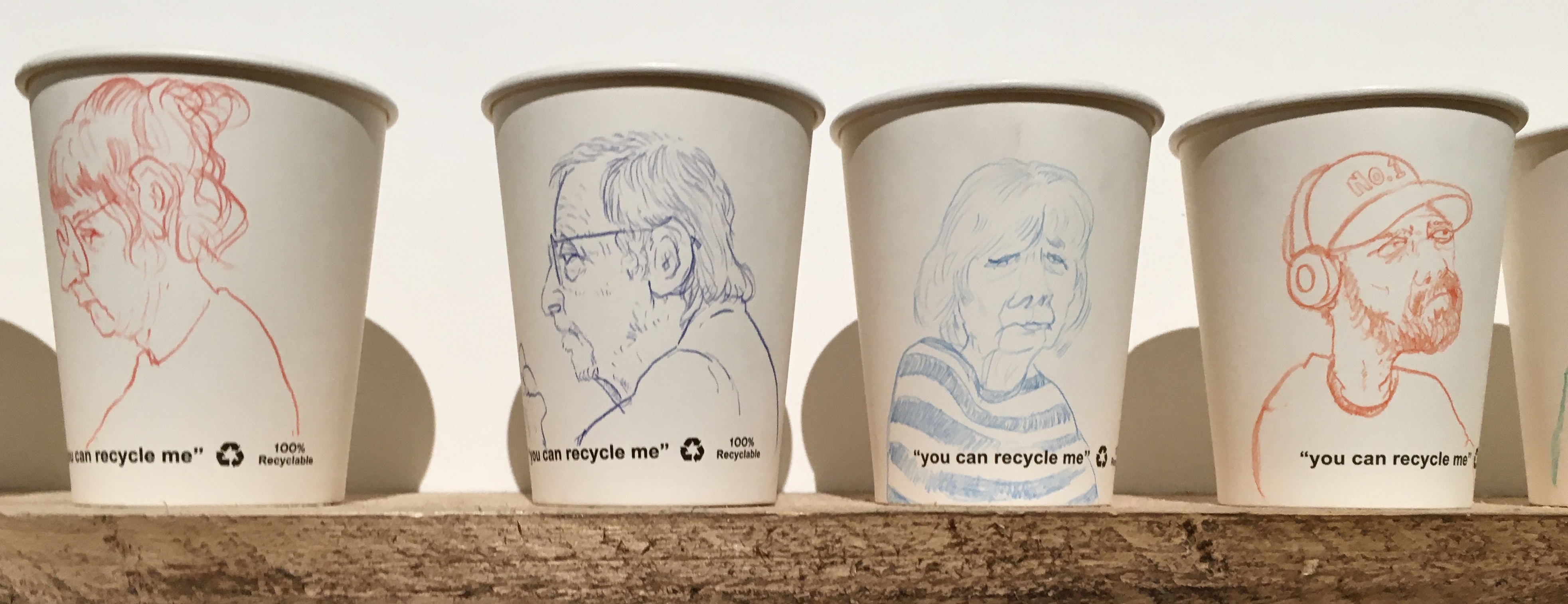
There is drawing on paper cups by Akash Byatt, a work made out of pencils arranged, Esteban Peña Parma, and the first prize winning wall of pottery vessel forms made out of steel wire by Max L Adam’s, each casting a shadow so ingenuity and unusual materials have been selected.


Then there are complex large works with social and political meanings like Simon Page’s ‘The End of Babel’ in  ink, and a big drawing evoking the huge space of ‘Kings’ Cross station’ in charcoal by Jeanette Barnes.


Marvellous portraits are there too - Jake Spicer’s ‘Esme’ in charcoal pencil and Roy Eastland’s silver point on gesso ‘Displaced Portrait’ from a series he made from found photos.

There is work to make you think, laugh, cry and feel moved to take up a drawing medium yourself.
Anyone can enter but most I look up have a long list of qualifications and exhibitions to show.

As I am leaving I find about 12 babies in nappies each with probably their mother, on a large mat, being introduced to the messy pleasures of paint. I’m so glad adult workshops aren’t held in public in our underwear, although it might give performance artists ideas. Most of the babies look completely bewildered.
However that’s not to say it’s not a pleasurable beginning to the possibilities of art.

And the drawing show in all its variety must stimulate a wide audience.